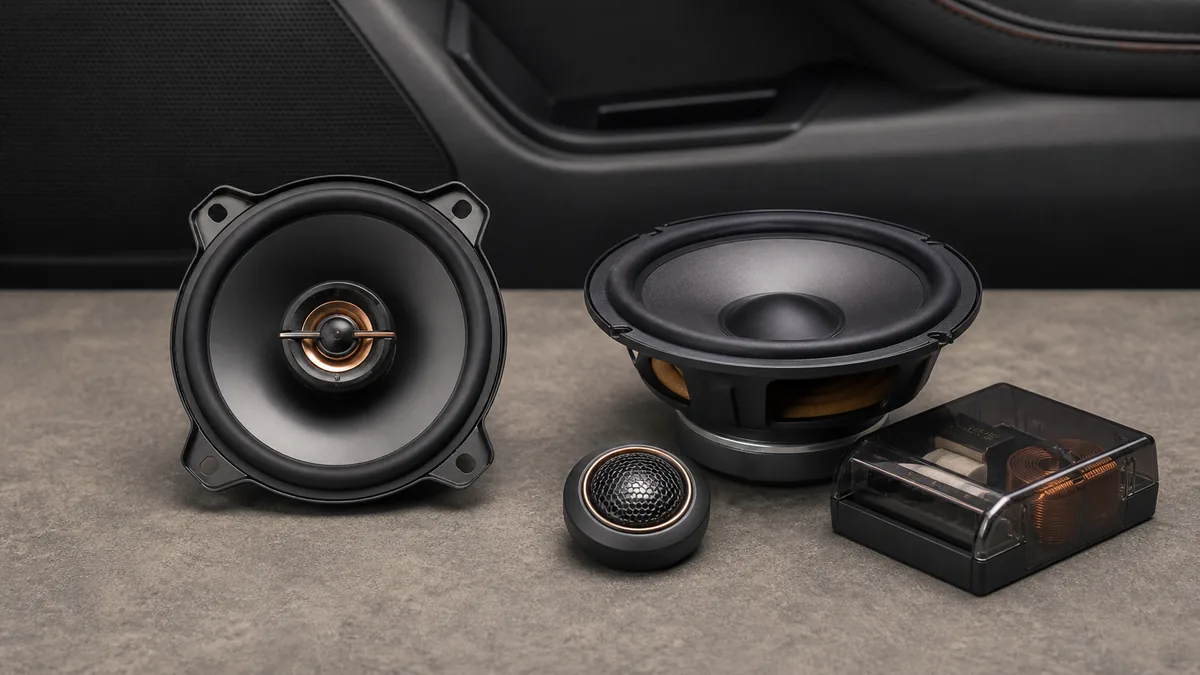
Coaxial and component describe how multiple loudspeaker-driver roles are packaged and installed. A coaxial speaker combines them in one assembly. A component system separates at least some drivers—commonly a woofer and tweeter—and provides or requires crossover behavior for those separate paths.
Neither architecture is automatically “better.” The useful choice depends on fit, placement options, crossover design, installation scope, tuning path, and the specific products being compared.
The structural difference
A typical coaxial car speaker places a smaller high-frequency driver near the axis of a larger cone. The assembly fits one speaker opening and normally receives one amplified channel through its integrated network.
A typical two-way component set separates the woofer and tweeter physically. It may include an external passive crossover, small inline networks, or a design intended for active filtering. The Crutchfield speaker glossary uses the same basic distinction while also showing that speaker terminology covers many variations.
“Component” does not guarantee a particular number of drivers. Two-way and three-way systems exist, and factory systems may already separate drivers without matching an aftermarket kit’s layout.
Comparison by user constraint
| Constraint | Coaxial speaker | Component speaker system |
|---|---|---|
| Packaging | Multiple driver sections in one assembly | Drivers are physically separated |
| Typical installation scope | Often uses one existing speaker location | Requires locations and mounting for separate parts |
| Crossover arrangement | Usually integrated into the assembly | May use an external network, inline network, or active processing |
| Placement flexibility | Driver geometry is largely fixed by the assembly | Tweeter and other drivers can be positioned separately |
| Tuning flexibility | Depends on the product and upstream processing | Can offer more independent control, especially in active systems |
| Main risk in comparison | Assuming simplicity means low quality | Assuming separation alone guarantees superior sound |
Why placement matters
Separating a tweeter creates placement choices. Those choices can change path length, directionality, reflections, and the relationship between drivers near the crossover region. More freedom can help a deliberate system, but it can also create more variables.
The Crutchfield component-speaker installation guide demonstrates that separate tweeter mounting and crossover placement are real installation decisions. It does not establish one universally correct location for every vehicle.
A coaxial assembly keeps the sources physically close and reduces mounting decisions. That can be valuable where factory locations must be retained or installation scope is limited. It does not mean every coaxial has identical dispersion or response.
Does component mean better sound quality?
Not by itself. Sound quality depends on more than product category:
- driver and crossover design;
- mounting rigidity and sealing;
- listening position and vehicle geometry;
- frequency response and directivity;
- amplifier behavior and available headroom;
- filtering, level, polarity, and timing;
- noise, vibration, and the source signal.
A well-integrated coaxial can be more coherent than a poorly placed or incorrectly filtered component set. A well-designed component system can provide placement and tuning options that a fixed coaxial cannot. These are conditional advantages, not universal rankings.
Which has more bass?
The category name does not answer that question. Low-frequency output depends on the larger driver’s design, mounting, acoustic loading, available clean power, filtering, excursion limits, and the vehicle. A separate tweeter does not automatically change the woofer’s low-frequency capability.
When users ask which type has “more bass,” they may actually be comparing two specific products with different cone area, sensitivity, response, or installation quality. Compare documented measurements and application requirements rather than the words coaxial and component alone.
Passive versus active component systems
Many component sets are designed around supplied passive networks. An active system instead filters the relevant channels before their power-amplifier stages and typically gives each driver path its own amplifier channel.
Active operation is not a free upgrade. It requires suitable processing, channel count, driver data, configuration, and measurement. This page does not provide active crossover settings or instructions for bypassing a supplied network.
Read what a crossover does before treating “active” as a sound-quality label.
A practical choice framework
Choose the architecture only after answering:
- Which factory locations and mounting depths are actually available?
- Can separate drivers and networks be mounted securely without interfering with vehicle systems?
- Will the system use the supplied passive network or documented active filtering?
- Is independent tuning part of the plan, or is a simpler replacement the real goal?
- Are the compared products evaluated under comparable conditions?
If the goal is a contained replacement in one opening, coaxial packaging may be the useful constraint. If the system genuinely benefits from separate placement and has the installation and tuning path to support it, a component layout may be appropriate.
Review what car-audio speakers do for driver roles and speaker sensitivity before comparing specification sheets.
Last verified: August 22, 2026.
Sources
- Crutchfield, Car speakers glossary.
- Crutchfield, Component speakers installation guide.