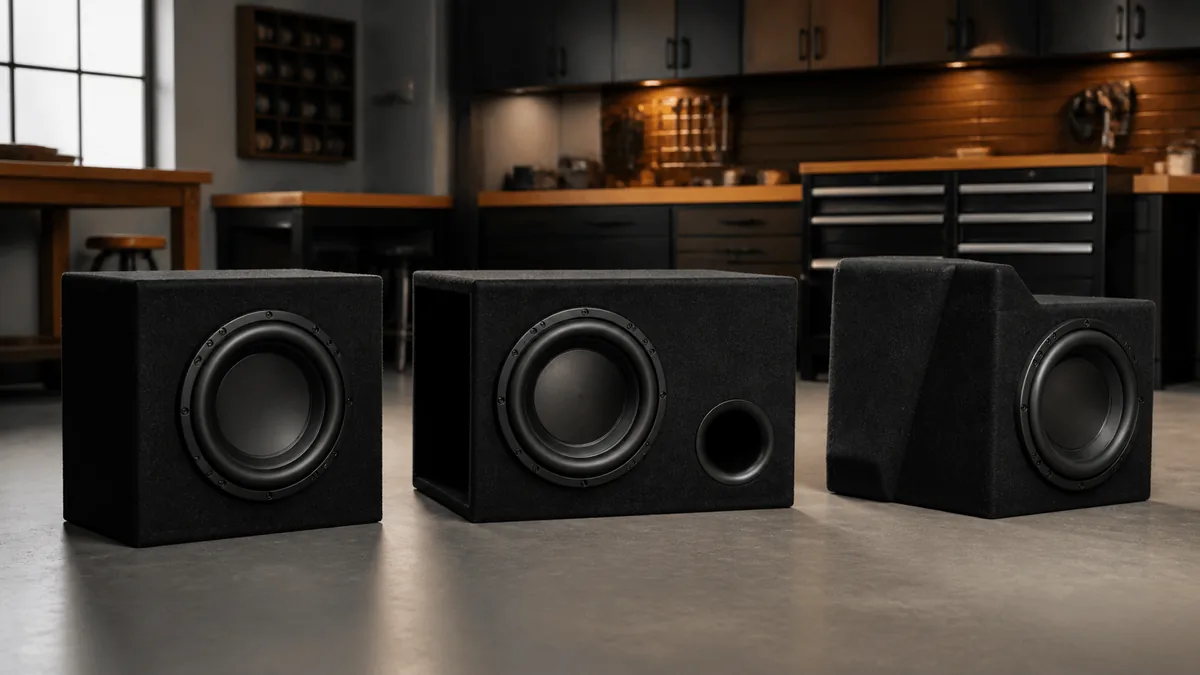
A subwoofer enclosure is part of the loudspeaker system, not merely a protective container. It controls how the driver’s front and rear radiation interact and changes the system’s response, excursion, efficiency, bandwidth, and practical packaging.
Sealed, ported, bandpass, passive-radiator, and infinite-baffle/free-air describe different loading arrangements. None is universally best, and the label alone does not predict “tight,” “musical,” or “loud” bass.
The enclosure-type map
| Type | Basic arrangement | Major design variables | Important constraint |
|---|---|---|---|
| Sealed | Driver radiates forward while its rear radiation is contained by a closed air volume | Net internal volume, leakage, fill, driver displacement, panel rigidity | A random small box is not automatically controlled or accurate |
| Ported / bass reflex | Driver and tuned vent contribute over part of the low-frequency range | Net volume, vent area, effective length, tuning, losses, driver parameters | Operation below the intended range may require system-specific filtering and excursion analysis |
| Bandpass | Driver operates inside chambers and sound exits through one or more vents | Chamber volumes, vent tuning, passband, losses, driver behavior | Design errors can be difficult to hear before the driver is stressed because the cone may be hidden |
| Passive radiator | A non-powered diaphragm replaces an open vent | Active and passive driver parameters, radiator mass and excursion, enclosure volume | The passive radiator must support the required displacement and tuning |
| Infinite baffle / free-air | A large baffle or vehicle structure separates front and rear radiation without a conventional small box | Separation quality, available rear air volume, mounting rigidity, driver suitability | “No box” does not mean “no acoustic enclosure” or universal driver compatibility |
This table is a concept map. It is not a design calculator.
Sealed enclosures
A sealed enclosure traps an air volume behind the cone. The driver, trapped air, leakage, damping material, and enclosure structure form the system.
Sealed designs are often simpler to construct than vented alignments, but “sealed” does not guarantee a particular sound. The result still depends on driver parameters, net volume, cabin response, placement, level, filtering, and construction.
Ported enclosures
A ported, or bass-reflex, enclosure uses a tuned vent so the vent contributes acoustic output over part of the operating range. Port dimensions and enclosure volume work together; changing one dimension without recalculating the system changes the result.
The Crutchfield sealed-versus-ported overview describes broad distinctions between these two common arrangements. Its general comparisons do not replace the subwoofer manufacturer’s enclosure data or a validated model for the intended vehicle.
Port area is not only a packaging choice. Air velocity, turbulence, effective length, bends, end effects, displacement, and available panel space can matter. This page intentionally provides no universal port formula or tuning target.
Bandpass enclosures
In a bandpass enclosure, the driver is mounted between acoustic chambers and the useful output reaches the cabin through a vented path. Different orders and arrangements exist.
Bandpass systems can concentrate output over a designed passband, but they introduce more interacting variables and can hide warning sounds from the driver. A generic box labeled “bandpass” does not establish bandwidth, efficiency, or safe operating range.
Passive-radiator systems
A passive radiator is a diaphragm without a voice-coil drive signal. Its moving mass and suspension participate in the enclosure tuning, serving a role related to a vent without requiring the same open duct.
It still needs displacement capacity, suitable parameters, mechanical clearance, and a specific design. Adding an arbitrary passive cone to a sealed box does not create a validated alignment.
Infinite baffle and “free-air”
An infinite-baffle installation uses a large separating surface so the driver’s front and rear waves do not readily cancel. In a vehicle, a rear deck, trunk boundary, or fabricated baffle may approximate that arrangement.
The term free-air commonly describes a driver intended for this kind of application. It does not mean the driver can operate safely with no mounting structure, no rear volume, or no excursion limits. The Crutchfield speaker glossary reflects the application term; the exact product documentation remains decisive.
Sealed versus ported is not a personality test
Searches often ask which is better for sound quality, bass, or a music genre. Those questions omit the alignment, driver, size, output target, cabin, placement, and listener priorities.
A strong sealed implementation can outperform a poor ported one, and the reverse is also true. Useful comparisons specify goals such as:
- usable bandwidth and low-frequency extension;
- maximum clean output in a defined range;
- enclosure and cargo-space limits;
- amplifier and electrical constraints;
- cone excursion and thermal demands;
- construction complexity;
- response at the listening positions.
Genre labels are weak design inputs because recordings within one genre vary and listeners may want different targets.
Net volume is not external box size
Manufacturer recommendations and enclosure models commonly use net internal volume. The finished external dimensions must also account for panel thickness, driver displacement, bracing, ports or passive radiators, and any internal structures. Vehicle fit adds clearance for mounting, ventilation, cargo, seat movement, and safe retention.
Do not copy dimensions without checking whether they describe gross external size, gross internal volume, or net working volume.
Choose the next level of guidance by risk
At the concept stage:
- Define the performance and space goals.
- Confirm that the exact driver supports the enclosure family.
- Collect manufacturer parameters and recommended alignments.
- Model the system with declared assumptions.
- Check excursion, vent or radiator behavior, amplifier limits, and cabin goals.
- Validate the finished system by measurement.
Those later calculations and construction steps are medium- or high-risk content and should not publish without stronger review. Start with what a subwoofer does if the driver, enclosure, and amplifier roles are not yet clear. Crutchfield’s subwoofer overview also illustrates why these parts must be considered as a system.
Last verified: August 22, 2026.
Sources
- Crutchfield, Sealed or ported subwoofer enclosures.
- Crutchfield, What are subwoofers?.
- Crutchfield, Car speakers glossary.