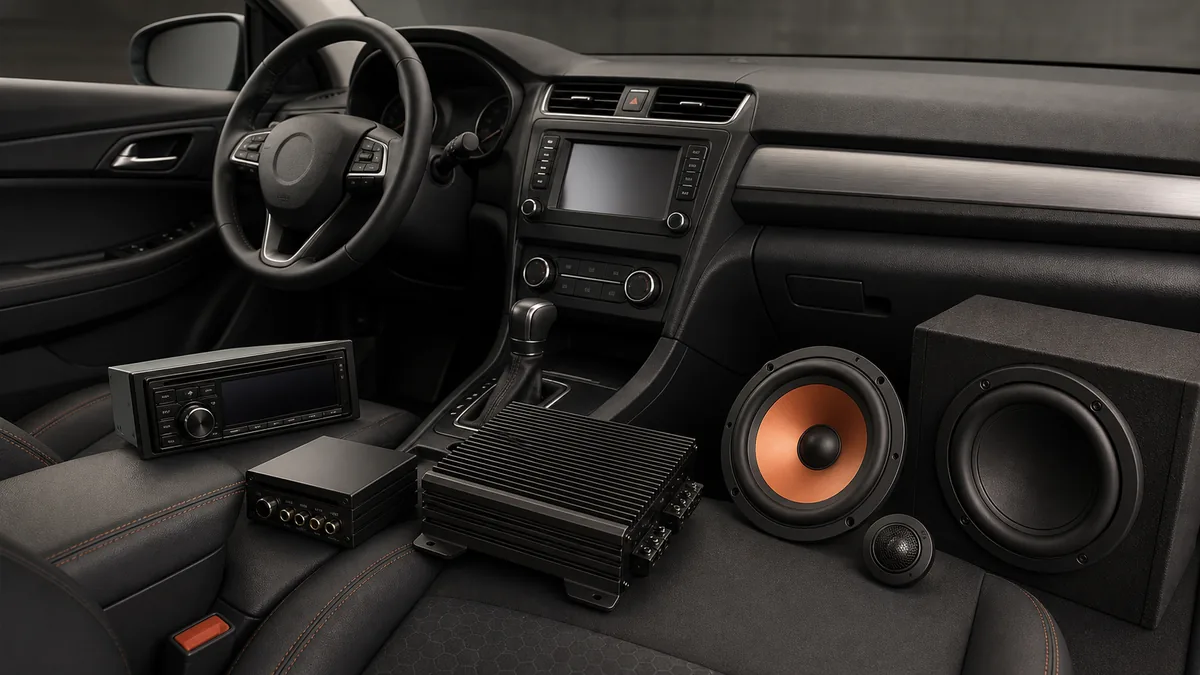
A car-audio system has two jobs: move audio information toward the loudspeakers and provide the electrical energy that lets the equipment do that work. Keeping those jobs separate is the easiest way to understand the system.
This page is a map, not an installation guide. It names the major blocks and shows how they relate without prescribing wiring, fuse sizes, or settings.
The audio path in one line
For a simple aftermarket system, the conceptual path is:
source → control and processing → amplification → loudspeakers → sound in the cabin
The physical products do not always appear as five separate boxes. A factory radio may combine the source, controls, processing, and amplification. An aftermarket receiver may contain a small power amplifier. A powered subwoofer combines an amplifier and loudspeaker enclosure. The functions still exist even when the hardware is combined.
| Function | What it does | Common examples |
|---|---|---|
| Source | Provides the program material | Radio, phone, USB storage, streaming service |
| Control | Selects the source and sets user controls | Factory interface, receiver, head unit |
| Processing | Changes or routes the signal | Equalizer, crossover, digital signal processor (DSP) |
| Amplification | Supplies a higher-power version of the audio signal | Receiver’s internal amplifier, external amplifier |
| Transduction | Converts the electrical audio signal into acoustic output | Tweeter, midrange driver, woofer, subwoofer |
The Analog Devices DSP introduction describes the digital portion of this chain: real-world signals can be converted to digital data, processed mathematically, then converted back to analog for loudspeaker playback. A system can cross between analog and digital more than once.
The power path is different
The music signal is not the same thing as the vehicle power supply. The power path begins with the vehicle’s electrical system and supplies energy to the audio equipment. The signal path tells that equipment what waveform to reproduce.
An external amplifier therefore needs both kinds of connection in principle:
- a power path from the vehicle electrical system;
- an audio input from the upstream source or processor;
- an amplified output toward the loudspeakers;
- control behavior that determines when and how it operates.
Published car-audio system diagrams commonly show these paths separately. For example, Crutchfield’s amplifier system diagrams distinguish power, signal input, and speaker output. That separation is useful for learning and diagnosis, but the diagrams are not a substitute for the manuals for a particular vehicle and product.
What each major component contributes
Receiver or head unit
The receiver is usually the visible control point. Depending on the vehicle, it may handle source selection, volume, radio reception, media playback, phone integration, conversion between digital and analog signals, equalization, and low-power speaker output.
In many modern vehicles the visible screen is only one node in a larger factory system. Amplification, routing, warning chimes, microphones, active noise control, and vehicle settings may live elsewhere. “Replace the radio” is therefore not a universal description of the task.
Signal processor
A processor deliberately changes the signal before the final power-amplifier stage. Possible functions include level control, equalization, filtering, channel routing, delay, and conversion between input and output formats. Some receivers and amplifiers contain these functions internally; a standalone DSP makes them more explicit and adjustable.
Amplifier
An audio power amplifier uses energy from the electrical supply to produce an output that can drive a loudspeaker. Its purpose is not to invent new musical information. The engineering goal is to reproduce the input waveform at the required output level while controlling noise and distortion; the Analog Devices amplifier overview describes this function in general audio terms.
Loudspeaker drivers
A loudspeaker driver is a transducer: it converts an electrical signal into mechanical motion and then sound. A system may divide the audio range among tweeters, midrange drivers, woofers, and subwoofers. Crossovers control which frequency regions are sent to which drivers.
Three distinctions that prevent confusion
A component is not the same as a function
One chassis can perform several functions, and one function can be distributed across several chassis. Ask “where does amplification happen?” rather than assuming it always happens in the dashboard.
A connector does not fully identify a signal
Two connections that look similar can carry signals with different level, format, channel assignment, or reference. A physical plug alone does not prove compatibility.
Factory systems are variable
Vehicle year, trim, option package, factory amplifier, network architecture, and software can change the signal path. Treat a generic system map as a vocabulary aid. Treat the exact service information and product manuals as the authority for a specific vehicle.
A sensible learning order
Start with how an audio signal moves through a car, then learn frequency and decibels. Continue with mono and stereo channels, analog and digital signals, and what loudspeakers actually do.
Those concepts make later topics—impedance, power, crossovers, gain structure, wiring, and troubleshooting—much easier to evaluate. The later topics also carry more technical risk, so Car Audio Atlas will not publish them merely to keep a daily schedule full.
What this map does not decide
It does not tell you which product to buy, where to connect a wire, whether an amplifier is compatible with a load, or how much current a system needs. Those decisions require product specifications, vehicle-specific information, calculations, and stronger review.
Last verified: August 22, 2026.
Sources
- Analog Devices, A Beginner’s Guide to Digital Signal Processing.
- Analog Devices, Class D Audio Amplifiers: What, Why, and How.
- Crutchfield, Amplifier wiring diagrams.