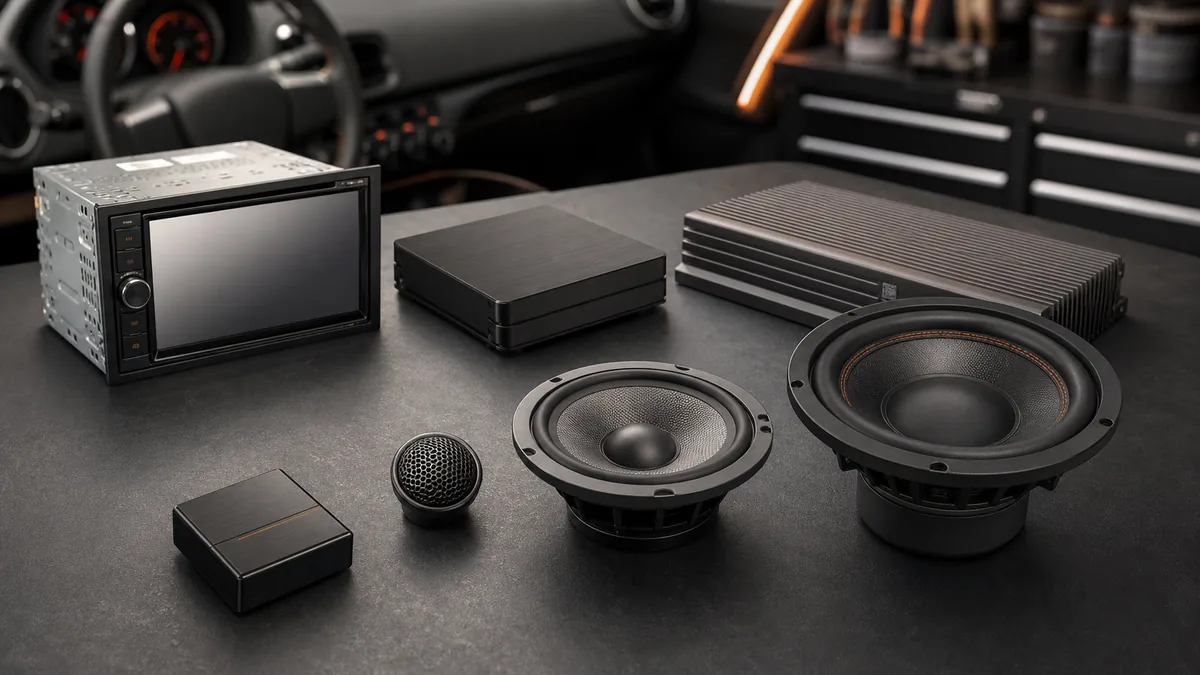
A car-audio component is a piece of hardware. A function is a job the system must perform. That distinction matters because one product can perform several jobs, while a complex factory system can distribute one job across several modules.
The useful question is not merely “what boxes are installed?” It is “where do source selection, processing, amplification, and sound reproduction happen in this system?”
Component map by function
| Function | Hardware that may perform it | What the label does not prove |
|---|---|---|
| Source and user control | Factory infotainment unit, aftermarket receiver, phone or media player | Signal format, output level, or easy replaceability |
| Conversion and processing | Head unit, factory amplifier, standalone DSP, DSP amplifier | Good tuning, flat output, or compatibility with another device |
| Power amplification | Head unit’s internal amplifier, factory amplifier, external amplifier, powered speaker | Safe speaker load, unclipped output, or a comparable power rating |
| Acoustic reproduction | Coaxial speaker, component speaker set, woofer, subwoofer | Usable bandwidth, safe filter, or sound quality in a vehicle |
| Signal adaptation | Line output converter, interface module, preamplifier, summing processor | That every factory feature and channel has been preserved |
| Frequency division | Passive crossover, receiver, DSP, amplifier | One universal crossover frequency or slope |
Texas Instruments’ automotive-audio overview uses a simplified head unit → amplifier → speakers model, then shows that DSP may be integrated into the head unit, implemented as a separate processor there, or located in an external amplifier. That is why the functional map remains useful when the visible boxes change.
Source and control devices
The head unit or factory infotainment interface is usually the visible control point. It may select radio, phone, USB, or another source; control volume; display information; and pass audio downstream. Some units also decode media, process channels, and power speakers directly.
A phone or portable player can be the program source without becoming the system’s master controller. The connection may carry analog audio, digital data, or a protocol that also carries commands and metadata. Connector shape alone does not define all of that behavior.
Learn the boundary in what a car stereo head unit does.
Processors and signal adapters
A digital signal processor (DSP) applies mathematical operations to digitized audio. The Analog Devices DSP introduction describes the general conversion-and-processing sequence: an analog signal can be converted to digital data, processed, and converted back to analog output.
In a car-audio product, available functions may include routing, summing, equalization, filtering, level changes, polarity control, and delay. Those are capabilities, not proof that the current configuration is correct.
A line output converter (LOC) adapts a signal for a different input arrangement, commonly when an aftermarket device must receive a factory speaker-level output. Some products perform only level/interface conversion; others also add summing, equalization-related correction, remote turn-on behavior, or DSP. The exact manual defines the actual product.
Continue with what a car-audio DSP does.
Power amplifiers
A power amplifier uses energy from its electrical supply to produce an audio output capable of driving a loudspeaker. Analog Devices describes the general engineering goal as reproducing the input audio at the required output level while controlling distortion and power loss in its audio-amplifier overview.
An amplifier may be:
- built into a head unit;
- a separate factory module;
- an aftermarket multichannel or mono chassis;
- combined with DSP;
- built into a powered subwoofer or other active speaker.
The word “amplifier” does not establish channel count, class, output capability, minimum load, signal input, or compatibility. Those are separate specifications.
Read what a car-audio amplifier does.
Loudspeakers and subwoofers
Loudspeakers convert an amplified electrical waveform into mechanical motion and acoustic output. A system may use tweeters, midrange drivers, woofers, and subwoofers for different regions of the audio range.
A coaxial speaker combines multiple driver sections in one assembly. A component set separates drivers physically and normally includes or requires crossover behavior. A subwoofer is a driver intended for the system’s lowest frequency region; it may be sold separately, in an enclosure, or with an amplifier as a powered unit.
Crutchfield’s speaker glossary documents common market terminology. A product manual and installation context are still required for actual bandwidth, power handling, mounting, and filtering decisions.
Crossovers are functions and sometimes components
A crossover changes signal level by frequency so different drivers receive intended regions. A passive crossover is hardware placed after amplification. Active filtering can live in a receiver, DSP, or amplifier before the relevant output stage.
Therefore, “does this system have a crossover?” may have more than one answer. The function can exist in software, electronic circuitry, a passive network, or several of those locations at once.
Factory systems do not always expose neat boxes
Modern vehicle audio can share modules, networks, microphones, warning chimes, hands-free calling, active noise control, and vehicle settings. The visible dashboard screen may not contain every audio function, and a factory amplifier may also handle processing or non-music signals.
This page does not decide what can be removed or connected in a particular vehicle. That requires the exact year, make, model, trim, audio option, applicable interface documentation, and vehicle information.
Use this section as a directory
Start with the head unit, then follow the signal into the amplifier and loudspeakers. Add the DSP concept when you need to understand routing, filters, EQ, or delay.
For the broader relationship between these devices and the vehicle power supply, return to the whole-system fundamentals map.
Last verified: August 22, 2026.
Sources
- Texas Instruments, How Highly Integrated DSPs for Premium Automotive Audio are Redefining the Driving Experience.
- Analog Devices, A Beginner’s Guide to Digital Signal Processing.
- Analog Devices, Class D Audio Amplifiers: What, Why, and How.
- Crutchfield, Car speakers glossary.