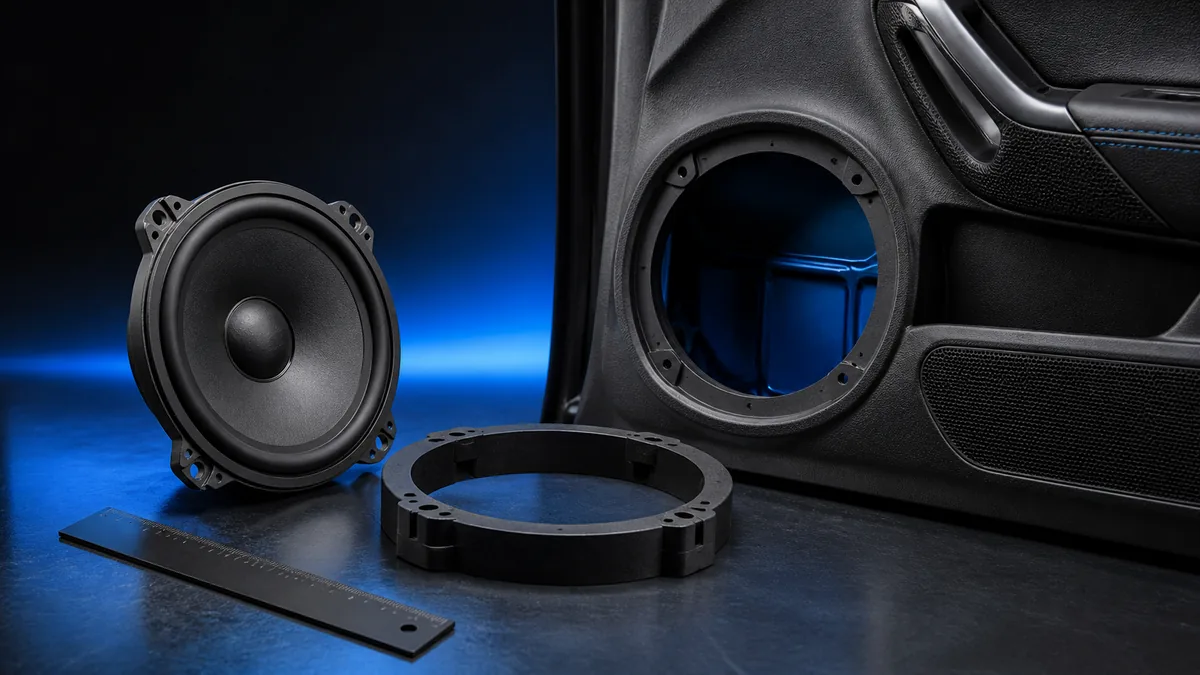
“6.5-inch speaker” is a category, not a guarantee that every 6.5-inch driver fits every 6.5-inch opening. A successful replacement must fit the vehicle’s opening, depth, mounting pattern, connector, grille, window path, and acoustic location.
The fitment record
| Check | What to verify | Why the label alone fails |
|---|---|---|
| Opening/cutout | Actual hole shape and diameter at that location | Factory openings may be oval, irregular, or use tabs |
| Mounting pattern | Screw locations, bracket, adapter, and baffle | A speaker can fit the hole but not the fasteners |
| Mounting depth | Magnet and basket clearance behind the panel | Window glass, regulators, and structure occupy the same space |
| Front height | Grille, trim, tweeter, and protrusion clearance | The cone can contact the grille or door panel |
| Connector | Vehicle plug, polarity, and adapter harness | Cutting a harness can create a new integration problem |
| Acoustic role | Woofer, coaxial, component, dash, center, or rear location | A physically fitting driver may not suit the signal path |
Crutchfield’s fitment guide emphasizes that vehicle location and dimensions matter beyond nominal diameter. Use a verified vehicle-specific selector when available, but treat its record as a starting scope, not permission to ignore the actual car.
Measure the location, not the old cone
The removed factory speaker may use a molded basket, unusual tabs, or an adapter that does not represent the metal opening. Record the cavity and the original bracket separately. Photograph the connector and fasteners before disassembly.
PowerBass’s application guide illustrates that cutout diameter, mounting depth, and panel fit are separate product dimensions. Its product dimensions are not a universal vehicle database.
Front and rear locations can differ
Door, dash, rear deck, pillar, and center locations can use different sizes, depths, impedance, enclosures, and signal processing in the same vehicle. Premium systems may apply equalization or filtering that makes a replacement sound unlike the original even when the basket fits.
For component systems, tweeter location and passive-crossover space create another fitment boundary. Use the installation planning guide before removing trim.
Stop at an unknown boundary
Do not force a basket against glass, cut structural metal, block a window mechanism, cover a drain, remove an airbag-related trim piece, or assume a factory amplifier accepts a replacement impedance. A bracket or harness adapter can solve one boundary while leaving depth, polarity, signal processing, or moisture exposure unresolved.
The best fitment answer is a complete measured record—not the largest speaker that shares a marketing size.
Last verified: August 23, 2026.
Sources
- Crutchfield, Car speakers: What’s going to fit my car?.
- PowerBass, S-Series Speaker Application Guide.