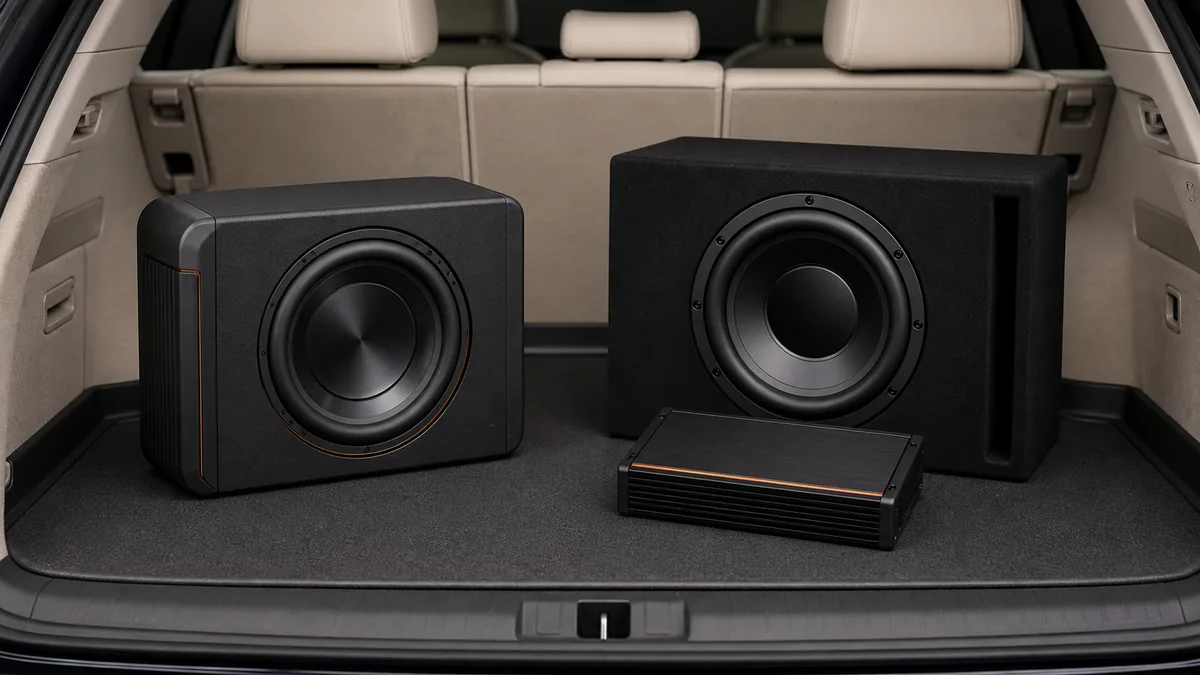
A powered car subwoofer packages a subwoofer, enclosure, and amplifier together. A passive—or unpowered—subwoofer system relies on a separate amplifier. That architectural difference affects packaging and flexibility, but it does not determine sound quality by itself.
Architecture compared
| Question | Powered subwoofer | Passive subwoofer system |
|---|---|---|
| Amplifier location | Built into the product/enclosure | Separate component |
| Driver/amplifier pairing | Chosen by the product designer | Chosen during system design |
| Packaging | Integrated unit, often compact | Driver/enclosure plus amplifier location |
| Upgrade flexibility | Usually replaced or upgraded as a package | Individual amplifier, driver, or enclosure may be changed |
| External connections | Still needs applicable power, ground, signal, and turn-on behavior | Amplifier and subwoofer each add their documented connections |
| Performance ceiling | Product-specific | Product- and system-specific |
Rockford Fosgate’s P300-8P documentation is a concrete powered example: the enclosure contains its own amplifier and accepts documented signal types. KICKER’s loaded Comp enclosure is a passive example that is intended to be paired with a separate amplifier.
“Powered” does not mean power-wire-free
The word means the amplifier is included, not that the unit powers itself from the audio signal. Crutchfield’s powered-subwoofer overview describes the package as subwoofer, amplifier, and enclosure together while still requiring the connections appropriate to an amplifier.
Exact conductor, fuse, ground, signal, and turn-on requirements are model- and vehicle-specific and are outside this comparison.
The strongest powered-sub advantage is integration
The manufacturer can choose the driver, enclosure, amplifier, filters, protection, and controls as one product. That reduces the number of independent component-matching decisions and can fit a constrained space.
The tradeoff is that enclosure volume, driver choice, amplifier capability, and upgrade path are bounded by that product. “All in one” is a packaging benefit, not proof that it will meet every bass-output goal.
The strongest passive-system advantage is flexibility
A separate system can offer more choices of driver, enclosure type, amplifier, mounting location, and future replacement. It also creates more compatibility questions: impedance, power ratings, enclosure suitability, filters, space, and amplifier limits must agree.
Read the subwoofer enclosure types map before assuming the built-in or separate amplifier is the only meaningful difference.
Neither category guarantees better sound
Results depend on the actual products, installation, available space, enclosure behavior, tuning, cabin, source signal, and output goal. A compact powered unit and a large custom passive system are not equivalent test subjects simply because both reproduce bass.
Scope boundary
This page owns the package comparison. It does not select a product, match impedance or power, or provide installation instructions. Those are separate commercial, system-design, and high-risk wiring intents.
Last verified: August 22, 2026.
Sources
- Rockford Fosgate, P300-8P powered enclosure.
- KICKER, Dual 12-inch Comp loaded enclosure.
- Crutchfield, How to install a powered subwoofer.