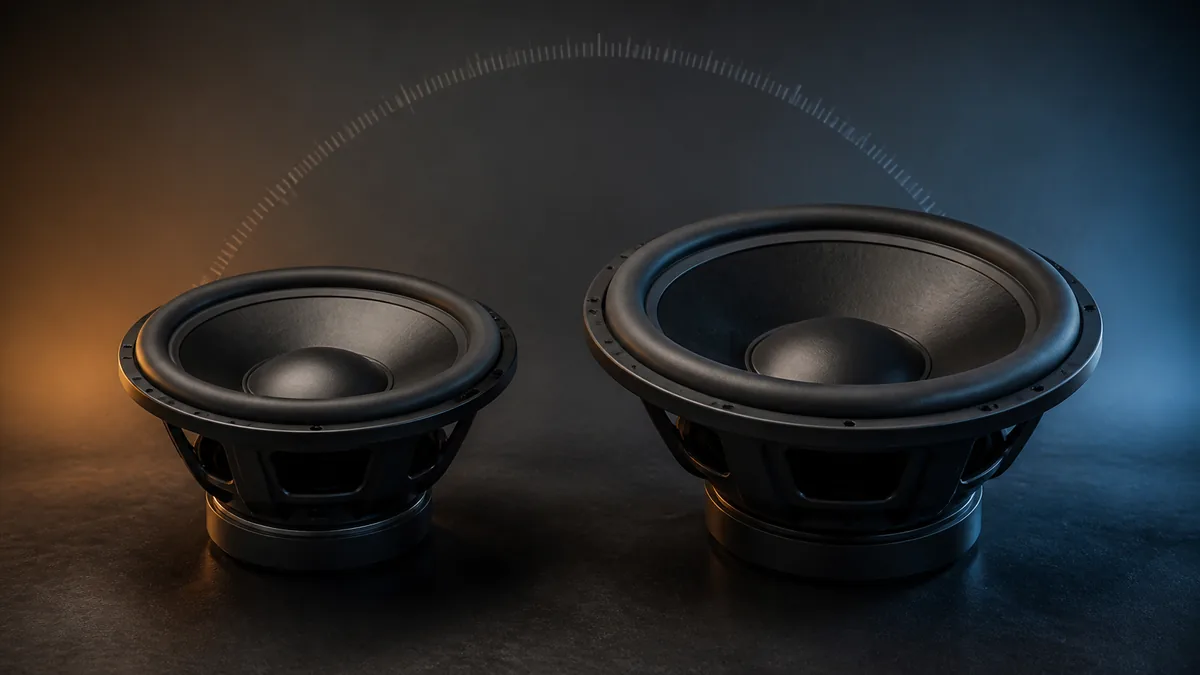
“A 10 is tighter; a 12 plays deeper” is not a dependable selection rule. Diameter affects potential cone area, but an installed subwoofer is a driver plus enclosure, amplifier, filters, cabin, and level target. A capable 10-inch system can outperform a poorly chosen 12-inch system, and the reverse can also be true.
Compare complete product records
| Record | What it can tell you | What diameter alone cannot tell you |
|---|---|---|
| Effective piston area (Sd) | Radiating area for that exact driver | Linear excursion or distortion |
| Linear excursion (Xmax, with method) | One part of displacement capability | Usable output across the whole band |
| Fs, Qts, Vas and manufacturer alignment | Helps define enclosure behavior | Installed response without a modeled box/cabin |
| Recommended sealed/vented net volume | Required usable airspace for that model | Whether the finished enclosure fits |
| Mounting depth and cutout | Physical fit boundary | Clearance for structure, wiring, grille, movement |
| Continuous power rating | Thermal input boundary under stated method | Guaranteed loudness or amplifier compatibility |
| Sensitivity conditions | A comparable measurement only when conditions match | Cabin output from mismatched test methods |
Two “12-inch” products can differ more from each other than one 10 and one 12 in a related family.
Where a 12 can have an advantage
If related drivers have similar motor capability and excursion, the larger effective cone area can contribute more displacement. That can support output goals with less excursion for a given air movement. But this advantage can be consumed by a smaller Xmax, power compression, enclosure mismatch, insufficient power, or installation constraints.
Rockford Fosgate’s system-design guide treats driver size as part of available-space and system-output planning. It does not turn diameter into a universal sound-character rule.
Where a 10 can be the better system choice
A 10-inch driver’s recommended enclosure and mounting geometry may fit where a particular 12 cannot. Preserving cargo space, correct net volume, port clearance, grille clearance, and secure mounting can produce a more successful installation than forcing a larger diameter into an unsuitable box.
KICKER’s box-building guide directs builders to the exact subwoofer’s recommended enclosure specifications. “Fits in the trunk” is insufficient: external dimensions, panel/brace/port displacement, and installed clearances all matter.
Speed, punch, and deep bass are system outcomes
Transient response and frequency extension depend on the driver’s parameters, enclosure alignment, filters, group delay, cabin transfer, seat position, and integration with the front speakers. Genre labels such as “10 for rock, 12 for rap” discard those variables.
Compare modeled response and excursion under the same constraints. Then listen or measure in the intended vehicle when practical. Read sealed vs ported for enclosure tradeoffs without the “tight versus boomy” shortcut.
A practical decision order
- Define listening/output goal and usable cargo-space envelope.
- Shortlist exact drivers—not diameter categories.
- Compare manufacturer enclosure, mounting, power, impedance, and excursion data.
- Model the exact enclosure and confirm finished fit.
- Match the final nominal load and continuous ratings to the amplifier record.
- Choose the complete system that meets the goal with documented margin.
Diameter is a filter for the shortlist, not the verdict.
Last verified: August 23, 2026.
Sources
- Rockford Fosgate, 2014 System Design Guide.
- KICKER, How to Build a Subwoofer Box.