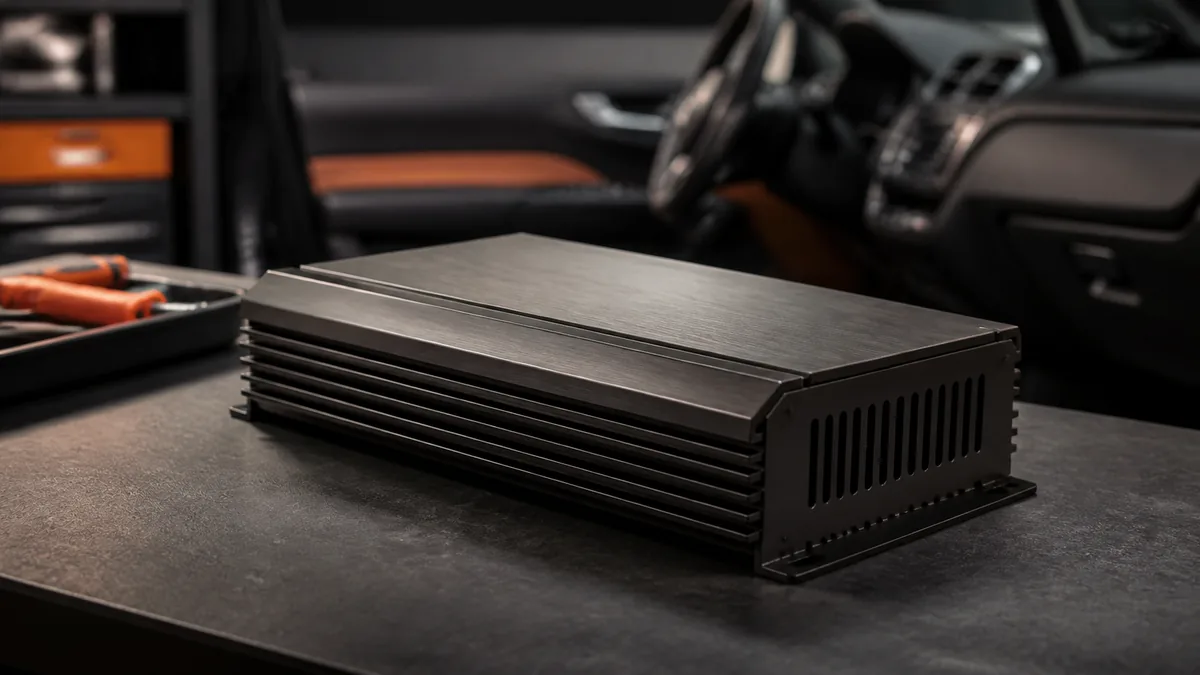
A car-audio power amplifier uses energy from the vehicle electrical supply to produce a higher-power audio output capable of driving loudspeakers. It follows the changing input waveform; it does not create missing musical information.
An amplifier can be built into a head unit, installed as a separate factory module, added as an aftermarket chassis, or combined with a DSP or powered speaker.
Input, function, and output
| Part of the amplifier job | What it means | What must still be specified |
|---|---|---|
| Audio input | Receives the waveform to reproduce | Signal type, level, channel assignment, and reference |
| Gain and amplification | Produces a larger output waveform using supply energy | Available clean output under stated conditions |
| Speaker output | Delivers voltage and current to a connected load | Supported load, channel/mode, wiring, and protection limits |
| Heat management | Removes energy not delivered as useful output | Installation airflow, chassis design, and operating conditions |
| Protection | May limit or shut down operation during faults | Exact trigger and recovery behavior in the product manual |
Analog Devices states the general goal of an audio amplifier as reproducing input audio at sound-producing outputs with the desired power and controlled distortion in its Class D amplifier overview. The details differ by amplifier design and operating condition.
Every speaker system has amplification somewhere
A small system may use only the amplifier built into its dashboard unit. A premium factory system may send signals to a separate multichannel amplifier. An aftermarket system may use one amplifier for full-range speakers and another for a subwoofer.
The absence of a visible external chassis does not mean the audio signal reaches speakers without amplification. It means the relevant amplifier may be integrated elsewhere.
What amplifier channels mean
An amplifier channel is one independently handled output path under the product’s specified operating modes. A two-channel amplifier can commonly reproduce left and right signals. A mono amplifier provides one output program channel and is often used for a subwoofer system.
Channel count is not speaker count. Several speakers can sometimes share a channel under an approved topology, and one speaker assembly can contain several drivers or voice coils. Those configurations affect load and compatibility, so they belong in separately validated material rather than this definition page.
Amplifier class describes circuit operation
Class labels such as A, AB, and D describe how the output stage operates. They are not universal sound-quality grades.
Analog Devices explains that linear and switching output stages have different power-dissipation behavior. Class D uses a switching output stage and generally offers a major efficiency advantage at higher output levels, which is valuable where heat and space matter. Actual noise, distortion, bandwidth, protection, and efficiency still depend on implementation.
Therefore:
- Class D does not automatically mean poor or perfect sound.
- Class AB does not automatically mean warmer or more accurate sound.
- A class label cannot replace measured specifications under stated conditions.
More power is not the same as more information
An amplifier can increase the available output voltage and current, but it cannot recover content already removed upstream. It also cannot correct channel routing, factory equalization, clipping from the source, a damaged loudspeaker, or poor mounting merely by having a larger power rating.
If the input waveform is already clipped or otherwise unsuitable, amplification reproduces that problem at its output within the amplifier’s own limits.
Ratings need conditions
An amplifier power number is incomplete without the measurement method and operating conditions. Relevant context can include supply voltage, load, channel configuration, frequency range, distortion limit, and whether all channels are driven.
The Consumer Technology Association maintains an in-vehicle amplifier measurement standard and related information on its 12-volt amplifier page. A standards reference helps comparison only when the product actually states compliance and the compared conditions align.
This page does not match an amplifier to a speaker, calculate a final load, or recommend wiring. Those are higher-risk tasks that require stronger product documentation, applicable deterministic calculations, adversarial review, explicit limitations, and the site’s high-risk safety notice.
Why amplifiers produce heat
No real amplifier converts all supply energy into useful speaker output. Semiconductor operation, switching, resistance, control circuitry, and other losses dissipate energy. Heat-sink shape, airflow, mounting, ambient temperature, load, and output demand affect operating temperature.
“Runs warm” is not a diagnosis, and a chassis being too hot to touch is not a calibrated measurement. Product-specific thermal or protect behavior belongs to its manual and a structured troubleshooting process.
Amplifier, preamplifier, and DSP are different roles
A preamplifier handles lower-level signals before the final power stage. A DSP mathematically processes digitized audio and may provide routing, filters, EQ, and delay. A power amplifier produces the speaker-driving output.
One chassis can combine all three roles. The components map shows the distinction, and what a DSP does explains why processing is not the same as power amplification.
Last verified: August 22, 2026.
Sources
- Analog Devices, Class D Audio Amplifiers: What, Why, and How.
- Consumer Technology Association, 12 Volt Amplifiers.
- Edmunds, The Amplifier: Understanding Car Audio Systems, Part 3.