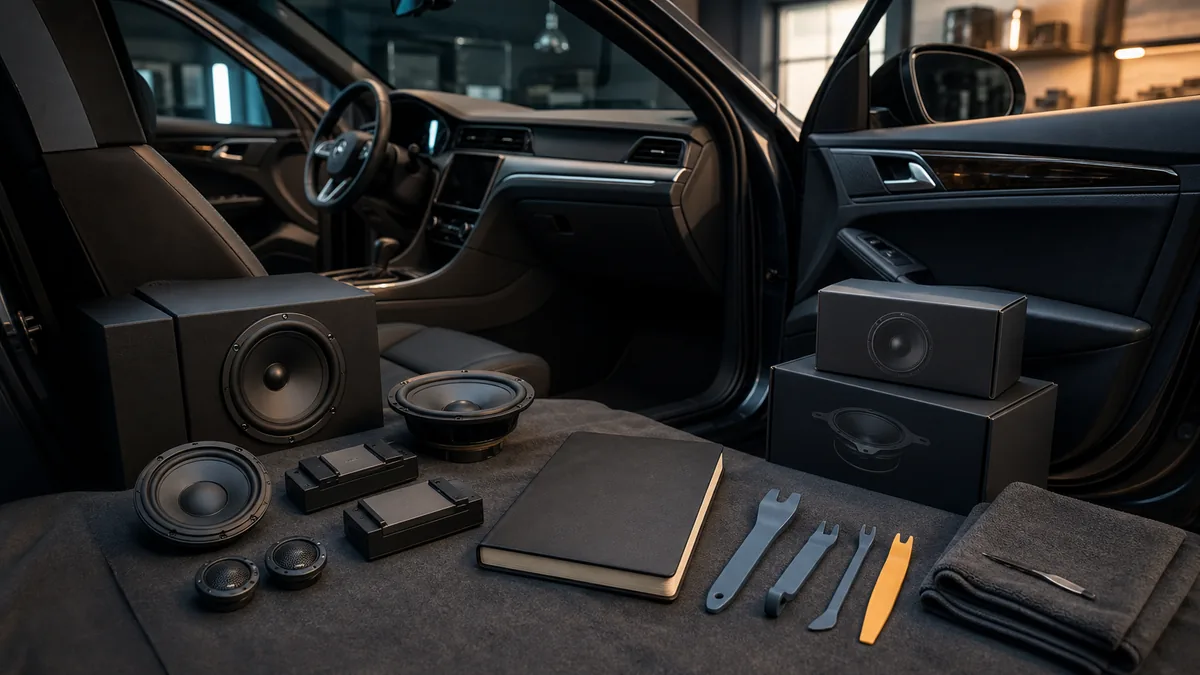
A reliable car-audio installation starts as a record of interfaces, not a pile of components. The installer must know what fits, what the vehicle already does, what each device expects, how power and signal move, and how the finished system will be verified.
This hub organizes those decisions. It is not a universal disassembly or wiring procedure.
Build the installation record
| Layer | Record before work begins | Why it matters |
|---|---|---|
| Vehicle | Exact year, trim, factory audio option, service information, retained functions | Vehicles with the same dashboard can have different signals and modules |
| Mechanical | Mounting depth, ventilation, fasteners, moving parts, airbags, water paths | Physical fit and safety cannot be inferred from a product photo |
| Electrical | Product supply range, protection, current path, isolation procedure | The manual owns limits and terminal requirements |
| Signal | Source format, channel content, level, processing, summing needs | A connector does not reveal the signal carried on it |
| Control | Remote output, accessory state, data interface, signal sensing | Turn-on behavior is product- and vehicle-specific |
| Acoustic | Speaker locations, polarity record, enclosure, intended tuning | Installation and tuning share dependencies but are not the same task |
| Verification | Baseline, test conditions, measurements, final inspection | “It plays” is not proof that every function or boundary is correct |
Preserve vehicle functions deliberately
Factory audio systems may participate in warning chimes, microphones, active noise control, hands-free calling, navigation prompts, equalization, or vehicle menus. Determine what must be retained and how it is routed before removing the source or intercepting a signal.
Use vehicle-specific service data and interface documentation. Wire color alone is not identity, and a continuity result alone does not describe signal content.
Separate power, control, and audio
The electrical and wiring map owns supply, return, fuse, conductor, and loaded-test prerequisites. The signal-path map follows audio from source to listener. The remote turn-on guide explains why a control input is neither the main power feed nor the audio signal.
Keeping these paths separate makes troubleshooting more precise. If an amplifier turns on but produces no sound, its control path may work while its signal path does not.
Product manuals define product behavior
AudioControl’s Epicenter amplifier manual and Rockford Fosgate’s Punch amplifier manual illustrate product-specific instructions for supply, grounding, remote turn-on, signal inputs, mounting, and protection. They are useful examples, not universal specifications for other amplifiers.
The exact current manual takes priority over a generic tutorial whenever values or terminal behavior differ.
Plan verification before installation
Capture a working baseline for every feature that matters. Define checks for source selection, channel assignment, balance/fader behavior, warning sounds, remote turn-on/off, noise, amplifier indicators, secure mounting, ventilation, and safe trim reassembly.
Change one layer at a time when practical. If everything changes simultaneously, a failure has too many possible boundaries.
Installation and tuning are separate gates
Installation QA confirms correct interfaces, secure hardware, protection, routing, polarity records, and basic function. Tuning changes level, filtering, equalization, delay, and related controls after the signal and hardware boundaries are known.
Visit the tuning and measurement map only after installation behavior is stable. Tuning cannot repair an intermittent power connection, a missing channel, or an incompatible interface.
Stop conditions
Stop when safe battery isolation is unknown, an airbag or safety-system harness is in scope, vehicle documentation conflicts, equipment cannot be secured or ventilated, or any conductor shows heat damage. High-voltage hybrid/EV systems are outside a general car-audio procedure.
Last verified: August 23, 2026.
Sources
- AudioControl, Epicenter 600/1200 Amplifier User Manual.
- Rockford Fosgate, 2019 Punch Full Range Amplifiers Installation & Operation.