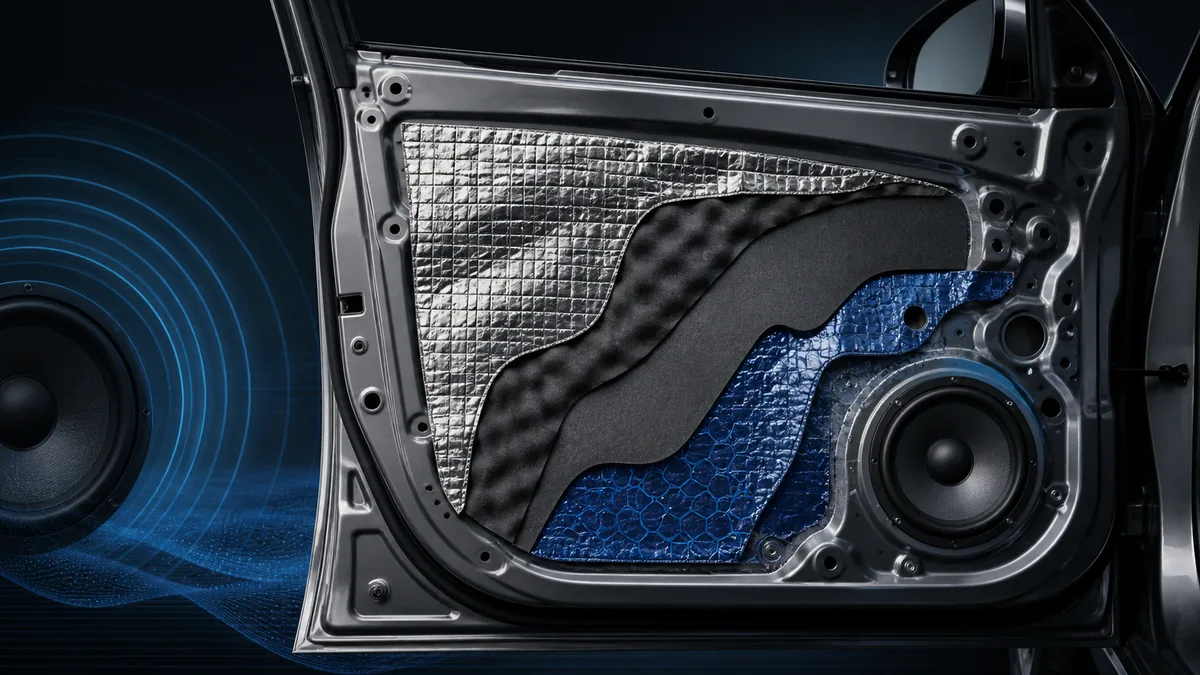
“Sound deadening” is used for several different jobs. A door treatment may reduce panel vibration, create a more stable speaker mounting surface, decouple trim, or reduce airborne road noise. One material does not automatically perform all four jobs.
Match the treatment to the problem
| Treatment role | What it addresses | What it does not guarantee |
|---|---|---|
| Constrained-layer damping | Panel resonance and flex | A quieter cabin or more bass in every location |
| Speaker gasket/decoupling | Air leaks and contact between speaker, adapter, and trim | Correct driver fitment or polarity |
| Air sealing around an opening | The speaker’s front/rear acoustic separation | Permission to block drains, mechanisms, or service access |
| Barrier/absorber material | Some airborne noise paths or reflections | Structural damping from every adhesive sheet |
| Foam/felt at contact points | Buzzing trim-to-metal or trim-to-trim contact | A replacement for loose fasteners or broken clips |
AudioControl’s technical paper on car acoustic treatment discusses the vehicle interior, door structure, and speaker integration as connected acoustic boundaries. The page is educational; exact materials and placement remain vehicle-specific.
Why doors affect speakers
A door can contain thin sheet metal, large access openings, a moisture barrier, moving glass, wiring, trim clips, and a speaker mounted through an adapter. Panel motion and air leakage can consume energy that should contribute to the intended acoustic output. A loose panel can also create a rattle that sounds like speaker distortion.
The speaker-installation plan owns fitment and service boundaries. Deadening cannot rescue a basket that hits the glass or a gasket that leaves an unplanned leak.
Coverage is not a universal percentage
Vendor pages sometimes provide coverage targets or a “whole door” recipe. Those can be product- and vehicle-specific. The useful starting point is the panel or contact that correlates with the symptom, while preserving drains, fasteners, access, moving parts, and water management.
Crutchfield’s vibration-damping guide states that installation depends on make, body style, location, and the problem being solved. Do not convert its general guidance into a universal coverage number.
Water, heat, and mass matter
Door interiors are not dry laboratory enclosures. The window seal can admit water, which must drain through designed paths. Material must adhere to a clean compatible surface without obstructing glass, latch/cable movement, airbags, service access, or drains. Added mass can affect trim retention and hinge/loading choices.
Stop when the substrate, adhesive, material temperature limit, or vehicle procedure is unknown. Do not cover a drain because it is convenient, add loose heavy material, or seal a service opening without understanding its role.
The best treatment is targeted: identify the vibration or acoustic boundary, select the material for that job, install it without compromising the door, and retest the original symptom.
Last verified: August 23, 2026.
Sources
- AudioControl, The Effect of Car Acoustic Treatment.
- Crutchfield, Vibration damping installation guide.