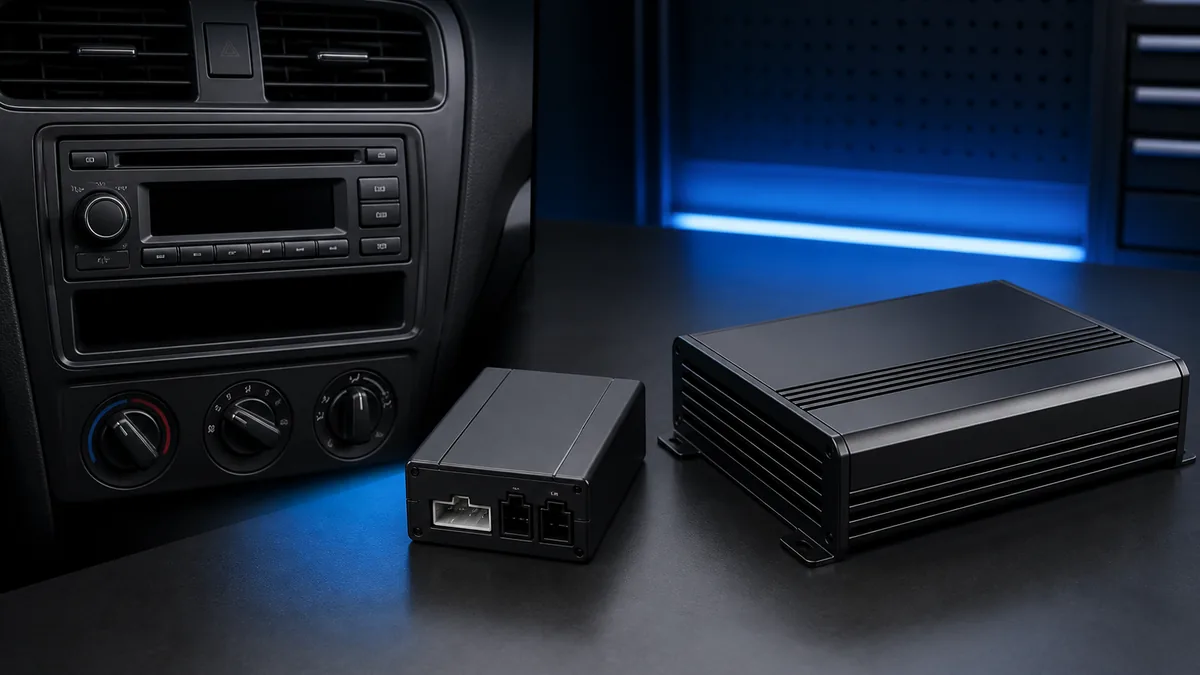
Adding an amplifier to a factory stereo is not simply “connect RCA cables.” Newer vehicles may have no conventional preamp output, a factory amplifier, processed speaker channels, network control, active noise cancellation, chimes, and level-dependent equalization.
Identify the factory architecture
| Factory boundary | What to discover | Possible integration class |
|---|---|---|
| Receiver output | Speaker-level, preamp, digital/network, or processed channel | Direct input, LOC, DSP, or vehicle-specific interface |
| Factory amplifier | Separate module, channel count, filters, network control | Retain, bypass, sum, or replace only with documentation |
| Channel content | Full-range, crossed-over, summed, delayed, or EQ-shaped | One input may not contain the whole program |
| Control features | Chimes, phone, navigation, ANC, fade, volume, diagnostics | Interface must preserve or intentionally handle them |
| Turn-on behavior | Remote lead, DC offset, audio sensing, data command | Product-specific trigger method |
Crutchfield’s factory-system guide describes separate paths for simple speaker upgrades, factory-amplified systems, and digitally controlled systems. Its vehicle examples are not a universal wiring map.
Choose the signal boundary
An amplifier with high-level inputs may accept the factory speaker output directly within its specified voltage/load range. A line-output converter can convert speaker-level signal to a preamp-level signal. A DSP/interface may be required when channels are filtered, summed, delayed, or equalized.
AudioControl’s LC2i PRO manual documents its own speaker-level inputs, signal-sense modes, power, ground, and setup boundaries. Those specifications belong to that product; they do not authorize tapping an unknown vehicle circuit or assuming every LOC handles the same factory output.
The Rockford Fosgate DSR1 documentation is another product-specific example: it distinguishes high-level, low-level, and vehicle-specific T-harness integration. Treat that as an example of integration classes, not as a universal compatibility list.
Preserve the vehicle functions
Before choosing hardware, record whether the factory amplifier carries warning chimes, hands-free audio, navigation prompts, center-channel content, ANC microphones, or volume-dependent processing. Removing or bypassing a module can create a no-sound, noise, or vehicle-function problem even if music plays.
Do not use a generic RCA diagram for a networked system. Identify the exact year, make, model, audio option, interface, and current manual. The system no-sound guide explains why a lit screen does not prove a complete audio path.
Plan power and control separately
Signal integration does not answer fuse, conductor, ground, amplifier-load, ventilation, or gain questions. Those are separate records. Use the electrical map and exact amplifier manual before installing high-current power.
Stop for unknown network wiring, airbag-adjacent harnesses, exposed high-current conductors, an interface outside its input range, or lost safety/chime behavior. Factory integration is a system-design problem, not a connector-color exercise.
Last verified: August 23, 2026.
Sources
- Crutchfield, How to upgrade your vehicle’s factory sound system.
- AudioControl, LC2i PRO User Manual.
- Rockford Fosgate, DSR1 Product Overview and App Setup.