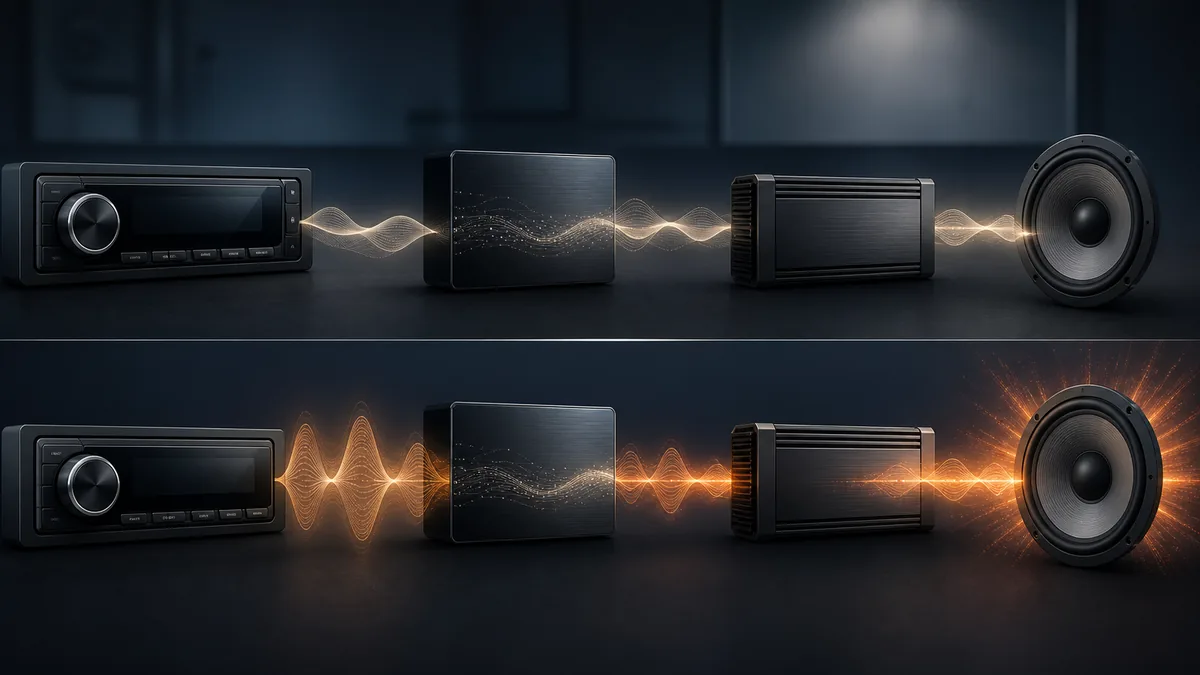
Speaker-level and line-level signals carry audio at different stages of the signal path. Speaker level has already passed through a power-amplifier stage; line level is intended to pass audio between compatible component inputs and outputs before the speaker-power stage.
Signal categories compared
| Term | Also called | Typical place in the path | Must be checked |
|---|---|---|---|
| Speaker level | High level, amplified output | Radio/factory amplifier output toward a speaker or compatible high-level input | Voltage range, differential/BTL behavior, processing, connector/pinout |
| Line level | Low level, preamp signal | Source/processor output toward an amplifier or compatible line input | Output type, voltage range, balanced/unbalanced behavior, connector/pinout |
| Converted line level | LOC output | After a compatible line output converter | Converter input range, output setup, load and signal behavior |
AudioControl’s LC6i manual identifies its input as accepting an amplified speaker-level signal from a factory source or amplifier, then provides preamp outputs for downstream amplifiers. Its LC-1.1500 guide separately identifies RCA analog line-level inputs.
High and low are relative labels
“High level” means higher signal level than the corresponding preamp/line path; it does not mean the vehicle’s main battery cable. “Low level” does not mean weak quality. These terms describe signal stage and interface expectations, not a universal sound-quality ranking.
The exact accepted range varies by product. Do not infer compatibility from the category name alone.
Connector shape is not enough
RCA connectors commonly carry line-level signals in aftermarket car audio, but the connector does not define every electrical property. Some equipment accepts speaker level through RCA-shaped sockets with a supplied adapter, while factory systems may use differential or unusual signal paths in multipin harnesses.
The product manual and vehicle documentation must identify signal type, range, polarity/reference behavior, and pinout.
When a line output converter enters the path
A line output converter accepts a compatible speaker-level signal and produces a line-level output for downstream equipment. But a converter is not automatically required whenever a factory radio is retained: some amplifiers or processors have suitable high-level inputs.
Crutchfield’s speaker-level input versus LOC overview also notes that input voltage range and factory-system behavior can determine whether a direct connection is appropriate. Read what a line output converter does for the component role.
Signal level does not reveal signal content
A factory speaker-level output may already contain equalization, filtering, volume-dependent bass behavior, warning chimes, or noise-cancellation content. Converting its level does not automatically remove that processing.
Integration therefore begins by identifying the signal, not by assuming that any speaker wire carries a full-range, flat source.
Scope boundary
This page defines two signal categories. It does not identify vehicle wires, recommend a tap point, select an LOC, or authorize connecting one product to another. Those steps require exact manuals, measurements, and a higher-risk integration review.
Last verified: August 22, 2026.
Sources
- AudioControl, LC6i User Manual.
- AudioControl, LC-1.1500 Quick Start Guide.
- Crutchfield, Speaker-level inputs or line output converter?.