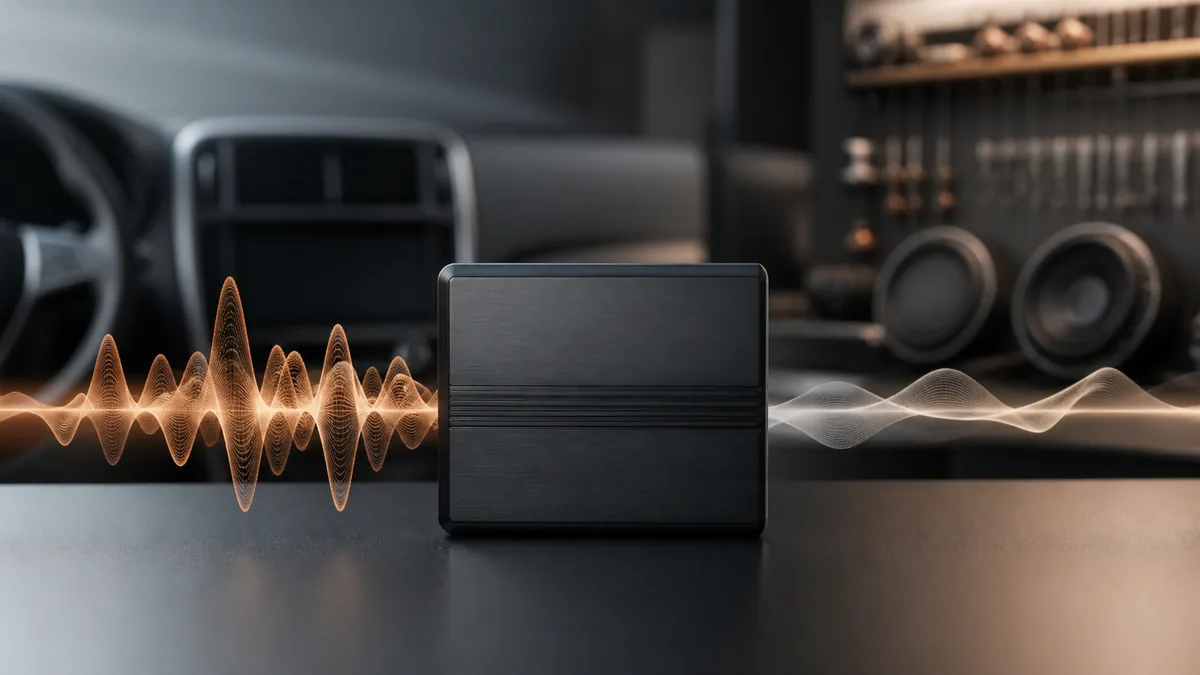
A car-audio line output converter (LOC) accepts an audio signal from one interface—commonly a factory speaker-level output—and provides an output intended for a compatible downstream line-level input.
The common nickname hi-low converter describes that level-changing role, but not every LOC is a simple passive voltage reducer. Products can add active circuitry, channel summing, load behavior, signal detection, level controls, or processing-related features.
Why an LOC may be needed
Aftermarket amplifiers often provide RCA-style line inputs. A factory source may expose only outputs intended to drive speakers, or its usable audio may come from a separate factory amplifier. An LOC can provide an interface boundary between that available signal and the downstream input.
The connector is not the complete specification. Before any integration decision, the actual source must be checked for:
- signal level and supported input range;
- channel content and bandwidth;
- common-ground, balanced, differential, or bridged behavior;
- factory equalization, filtering, delay, or volume-dependent changes;
- load detection or fault monitoring;
- warning chimes, microphones, active noise control, and other vehicle functions.
This is why an LOC cannot be selected safely from “speaker wires plus RCA jacks” alone.
LOC versus related devices
| Device or feature | Main role | When it may remove a separate LOC | What still requires verification |
|---|---|---|---|
| Basic LOC | Adapts an available higher-level audio output to a line-level input arrangement | Not applicable; it is the converter | Input range, output capability, grounding/reference, channel content |
| Amplifier high-level input | Lets a compatible amplifier accept a supported speaker-level signal directly | When its documented input suits the actual source | Voltage range, input topology, turn-on behavior, factory processing |
| Vehicle-specific interface | Preserves or extracts signals/functions for defined applications | When it supplies a documented compatible output | Exact year, model, trim, factory-audio option, firmware and harness |
| DSP with high-level inputs | Combines adaptation with routing or processing | When the processor’s inputs and outputs cover the job | Summing, bandwidth, delay, EQ, output level, configuration |
| Preamplifier output from a head unit | Provides a line-level output directly | When it is available and compatible | Rated level, channel assignment, filtering and control behavior |
AudioControl’s line output converter range demonstrates how products sold under the same category can include different channel counts and added functions. The category name therefore does not establish one universal circuit or capability set.
Passive and active LOCs
A passive LOC generally uses a passive network to reduce or transform the available signal. It does not require a separate power connection for its basic conversion function.
An active LOC uses powered electronics and may provide additional output capability, adjustment, summing, signal sensing, or correction features. “Active” does not automatically mean transparent, compatible, or correctly configured; it only describes an implementation family.
Product manuals define input limits and behavior. Do not assume a powered converter can accept any factory output or that a passive converter presents the load a factory system expects.
An LOC does not remove factory processing
If the source signal is filtered, equalized, delayed, limited, or volume-dependent before it reaches the converter, ordinary level conversion does not reconstruct the missing or altered information.
Crutchfield’s overview of factory sound processors and integration shows why summing and processing may be required in some systems. Those examples are not proof that every vehicle needs a DSP, nor that every set of speaker outputs can be summed safely.
Where DSP overlaps
Some processors accept speaker-level inputs and provide line-level outputs. The AudioControl DM-series manual documents one example with input routing, summing, equalization, filtering, delay, and output controls.
That makes it more capable than a basic level converter, but also creates more configuration requirements. A DSP cannot recover program content that is absent from all available inputs, and it cannot infer undocumented vehicle behavior.
Read what a DSP does for the processing role and the signal-path guide for the larger system context.
RCA output does not prove the signal is right
An RCA connector on the output side identifies a physical connector family. It does not by itself guarantee:
- full-range content;
- low noise;
- absence of clipping;
- flat frequency response;
- sufficient or standardized voltage;
- correct left/right or front/rear assignment;
- compatibility with a particular amplifier input.
Measure and document the signal path instead of treating the connector as evidence.
Questions before choosing an interface
- Where is the usable audio signal in this exact vehicle and factory option?
- What voltage, topology, bandwidth, and processing does it have across volume settings?
- Does the downstream device already provide a documented compatible high-level input?
- Are summing, load generation, signal restoration, or vehicle functions part of the job?
- Which manuals cover the interface, amplifier, vehicle, and retained features?
The answers determine whether the system needs a basic LOC, an active converter, a processor, a vehicle-specific interface, or no separate converter. Actual wire identification and connection procedures remain vehicle- and product-specific higher-risk work.
Last verified: August 22, 2026.
Sources
- AudioControl, Line Output Converters.
- AudioControl, DM-608 and DM-810 Installation Manual.
- Crutchfield, Factory sound processors and integration.