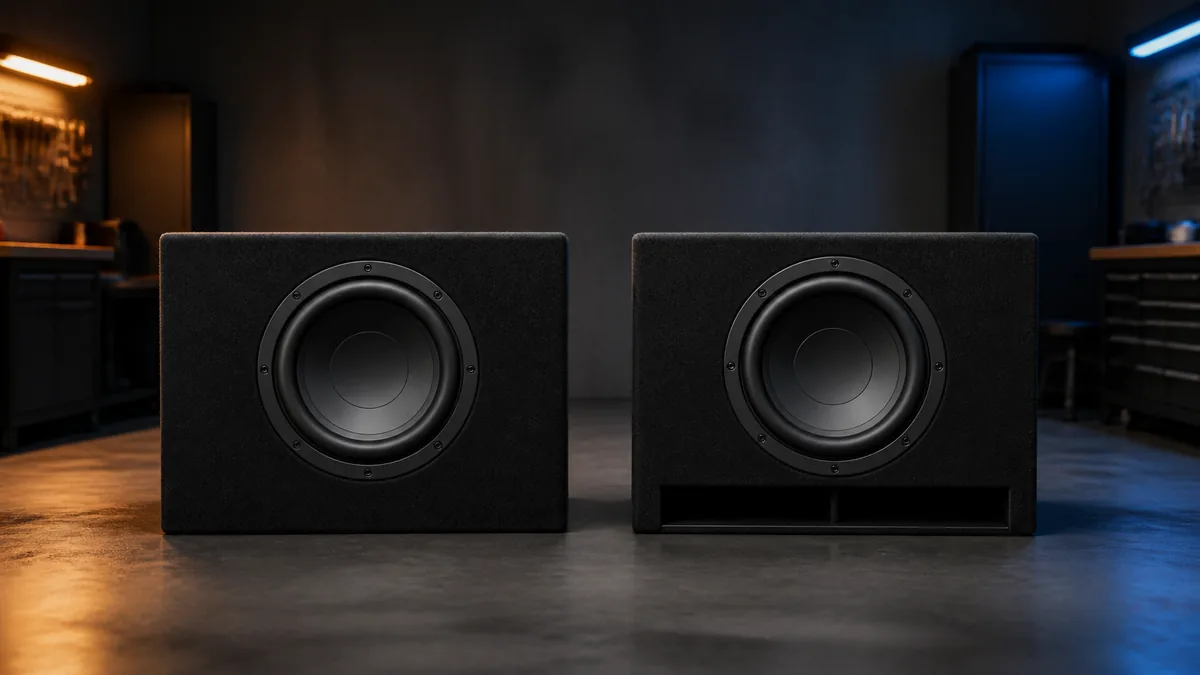
A sealed enclosure contains the subwoofer’s rear radiation in a closed air volume. A ported, or vented, enclosure adds a tuned duct so the driver and vent contribute over part of the operating range. That structural difference creates tradeoffs; it does not assign a sound-quality personality.
The practical comparison
| Design factor | Sealed enclosure | Ported enclosure |
|---|---|---|
| Main variables | Driver parameters, net volume, leakage, fill and losses | Driver parameters, net volume, vent area, effective length, tuning and losses |
| Packaging | Often simpler and potentially smaller for the same driver | Commonly needs more volume plus a physically workable vent |
| Output behavior | Driver supplies the acoustic output | Vent contributes strongly around the designed region |
| Excursion behavior | Enclosed air affects cone motion across the range | Cone motion can rise rapidly below the useful tuning region |
| Construction sensitivity | Airtightness, rigidity and correct net volume matter | Those factors plus vent geometry, clearance and turbulence matter |
| Design failure mode | Wrong volume or leakage changes the alignment | Wrong volume or vent changes tuning and may create noise or unsafe behavior |
KICKER’s enclosure-type paper and MTX’s sealed/vented overview describe broad manufacturer tradeoffs. Exact claims belong to the chosen driver’s data and the modeled alignment.
Neither type guarantees a sound character
“Sealed is tight and musical” and “ported is loud and boomy” are unreliable shortcuts. Transient behavior and perceived bass depend on the complete response, driver, alignment, group delay, distortion, cabin transfer, placement, filtering, level, and recording.
A well-designed ported system can be accurate. A badly sized sealed box can have an unwanted response or excessive demand. Compare implemented systems, not enclosure labels.
Ported output is frequency-specific
A vented system can provide more output or efficiency over a designed range because the vent contributes. That advantage is not uniform at every frequency. Below the useful range, the vent no longer protects the driver from large motion in the same way, so some manufacturer applications call for a product- and alignment-specific high-pass or subsonic filter.
Do not copy a filter value from another box. The exact driver, net volume, vent, tuning, amplifier, and intended program material control that decision.
Space must be compared on finished geometry
Port volume, driver displacement, braces, panel thickness, vent clearance, and mounting depth all consume space. An advertised internal airspace is not the same as the external dimensions that must fit the vehicle.
KICKER’s box-building guide shows why internal dimensions and component displacement must be accounted for. The gross-versus-net volume guide separates the terms.
Cabin response can reverse an assumption
The vehicle contributes its own frequency-dependent transfer behavior. Placement and cabin geometry can change the result at the seats, so an alignment that models one way in free space may measure differently after installation.
Read cabin gain as a variable system effect, not a fixed bass bonus that can be added to every design.
Choose using declared priorities
Compare candidate alignments against:
- verified driver suitability and manufacturer data;
- usable bandwidth and output target;
- finished external size and cargo constraints;
- modeled cone excursion and vent behavior;
- amplifier, electrical, and thermal limits;
- construction skill and repeatability;
- required filtering and tuning capability;
- measured response in the vehicle.
If the manufacturer provides only one recommended enclosure family for a specific driver, that evidence outweighs a generic preference. If no validated model or manual supports the proposed box, the comparison is not ready for construction.
Last verified: August 23, 2026.
Sources
- KICKER, Types of Subwoofer Enclosures.
- MTX Audio, Vented vs Sealed Subwoofer Enclosures.
- KICKER, How to Build a Subwoofer Box.