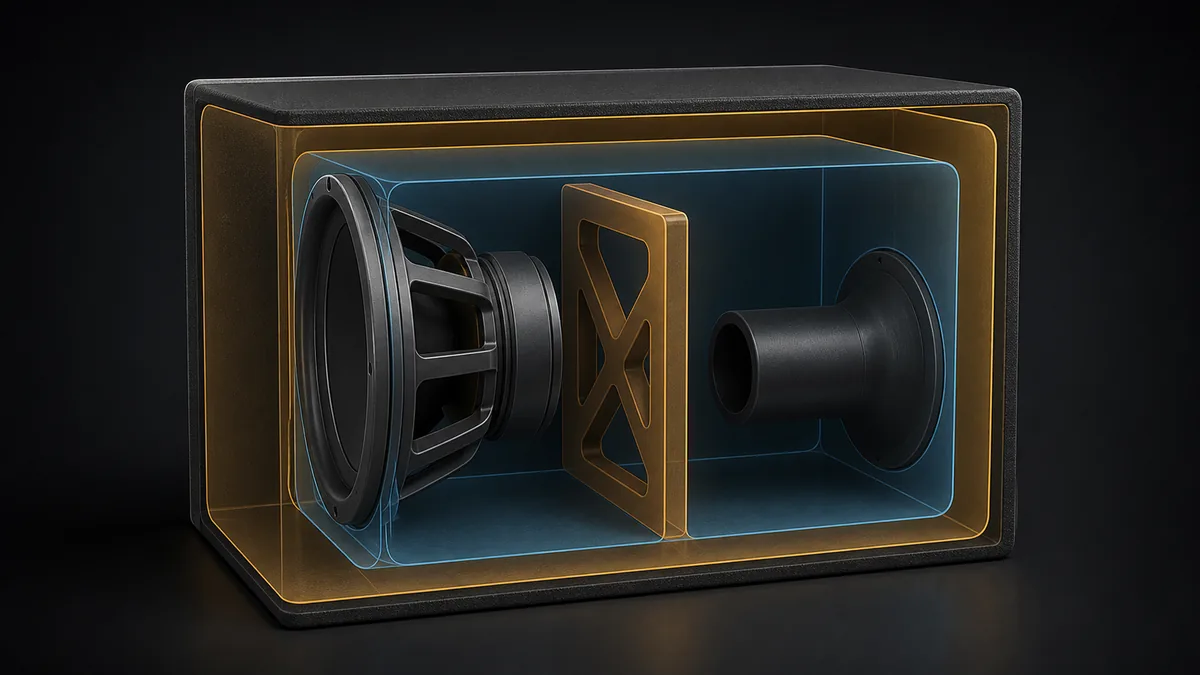
Subwoofer enclosure dimensions can refer to three different boundaries: the outside of the finished cabinet, the empty cavity inside its panels, or the airspace remaining after the driver and internal parts occupy volume. Confusing them changes the designed alignment.
The three volume terms
| Term | Boundary | Includes occupied internal parts? |
|---|---|---|
| External volume | Outside width × height × depth | Includes panels and everything inside; not usable airspace |
| Gross internal volume | Interior cavity bounded by the inside faces of panels | Usually measured before subtracting the driver, vent, braces and hardware |
| Net internal airspace | Working air volume after declared displacements | No; specified occupied volumes have been removed |
Terminology is not perfectly consistent across manufacturers. Always read the note attached to a recommended volume or dimension drawing instead of relying on the word “net” alone.
Why external dimensions are not airspace
Panel thickness reduces each internal dimension. A cabinet measured only from its outer faces includes the wood or composite material itself. Double baffles, inset panels, angled backs, and irregular shapes add more differences between a quick outside calculation and the real cavity.
KICKER’s box-building guide explicitly distinguishes internal and external dimensions and directs builders to account for subwoofer and brace displacement.
What commonly displaces air
The subtraction record can include:
- the portion of each subwoofer inside the enclosure;
- a slot or round port and its internal walls;
- braces, ribs, double-baffle intrusions, and dividers;
- terminal cups or connection hardware that protrude inside;
- passive radiators or other internal structures.
Fasteners and small fillets are often insignificant at practical precision, but that is a design judgment. Large braces and vents are not optional corrections.
The validated relationship
Using one consistent unit throughout:
net internal airspace = gross internal volume − total declared occupied volume
For example, a gross internal cavity of 2.25 ft³ with declared driver, vent, and brace displacements of 0.12 ft³, 0.18 ft³, and 0.05 ft³ leaves 1.90 ft³ net airspace.
That arithmetic is covered by the repository’s deterministic netEnclosureVolume() test. The example validates subtraction only; it does not say that 1.90 ft³ suits any particular driver or tuning.
Ported boxes create a circular dependency
A vent occupies volume, while its required geometry depends on the enclosure alignment. Changing vent area or length can change both tuning behavior and displacement. If the net target must stay fixed, the gross enclosure may need to grow after the vent is designed.
This is why adding a port to a completed sealed box is not a valid conversion method. The complete driver, net volume, vent geometry, tuning, and excursion behavior need to be modeled together.
Manufacturer conventions control the record
Product manuals may provide net airspace, external cut lists, suggested dimensions, or displacement notes. KICKER’s Comp manual is one example of model-specific enclosure tables and construction notes. Use the exact current manual for the exact driver.
If a listed recommendation does not state whether driver or vent displacement is included, stop and ask the manufacturer. Do not silently choose the interpretation that makes existing dimensions fit.
A useful calculation sheet
Record:
- all dimensions and their measurement boundary;
- panel thickness and any double layers;
- gross internal cavity calculation by shape;
- each occupied item as a separate line with its source;
- final net airspace in one unit;
- the manufacturer target and tolerance, if published;
- the finished measured dimensions and any construction change.
The sealed-versus-ported guide explains why volume is only one enclosure variable. A correct volume subtraction cannot validate a driver choice, vent design, power level, or safe filter.
Last verified: August 23, 2026.
Sources
- KICKER, How to Build a Subwoofer Box.
- KICKER, 2016 Comp Subwoofer Owner’s Manual.