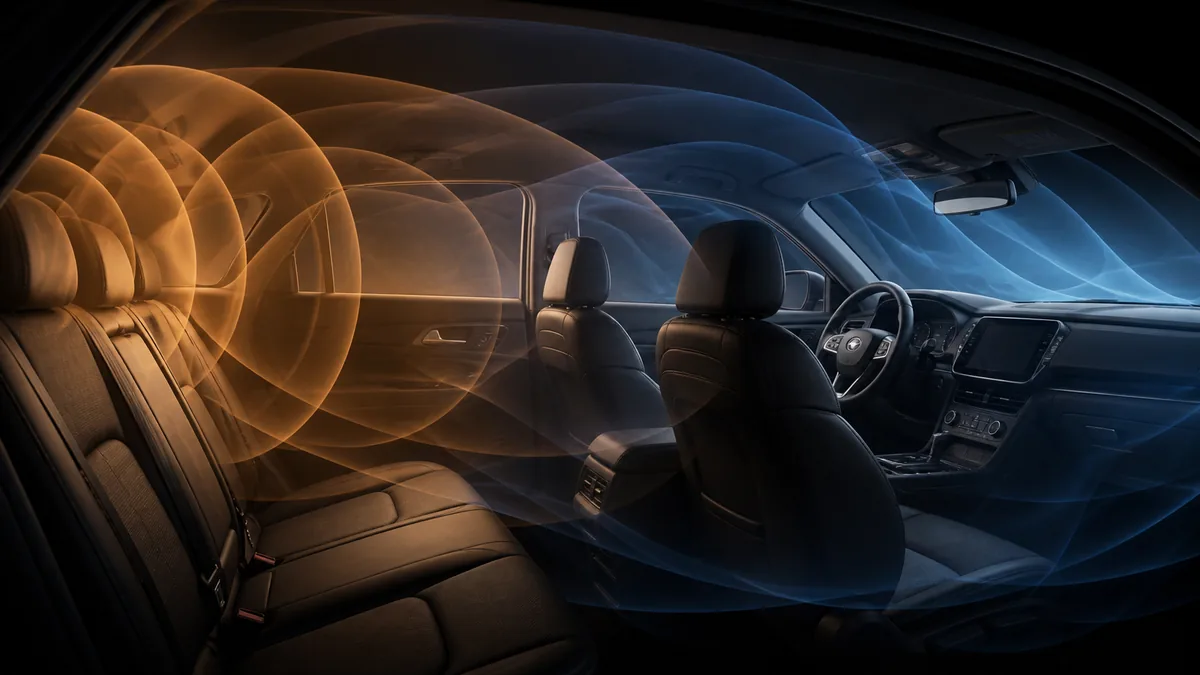
Cabin gain is informal car-audio language for the low-frequency increase a vehicle interior can contribute compared with a less confined acoustic condition. The useful idea is real; the popular shortcut of adding one fixed slope to every enclosure model is not.
What is confirmed and what is variable
| Claim | Classification | Why |
|---|---|---|
| The vehicle cabin changes low-frequency response | Confirmed | Measurements and acoustic models show a cabin transfer effect |
| Low-frequency gain can increase as frequency falls over part of the range | Confirmed, bounded | Published vehicle measurements show the trend, not one universal line |
| Every car adds the same dB per octave | Unsupported as a universal rule | Geometry, leakage, damping, source and receiver position vary |
| One near-field subwoofer measurement predicts every seat | Unsupported | Cabin paths and positions produce different transfer functions |
| Cabin behavior should influence enclosure and tuning decisions | Expert practice supported by measurement | The installed response is the design outcome that listeners receive |
SAE’s low-frequency automotive-audio paper reports acoustic gain in the lower musical octaves while emphasizing that complex vehicle geometry makes prediction difficult. That combination is the central point: gain exists, but it is not a universal constant.
Why a small cabin changes bass
At low frequencies, the cabin dimensions, boundaries, leakage paths, and source position interact with wavelengths that are large relative to the interior. Pressure behavior, reflections, structural transmission, and acoustic modes shape the response between the subwoofer and each listening point.
The result is better described as a vehicle transfer function than as free output from the subwoofer. A recent SAE full-band simulation study treats perceived sound as dependent on both the loudspeaker source and the cabin path, and validates predictions against measured passenger-ear transfer functions.
Why published rules of thumb disagree
Several variables can change the apparent gain:
- sedan, hatchback, SUV, pickup, or open-cabin geometry;
- trunk pass-throughs, folding seats, vents, windows, and panel leakage;
- subwoofer and vent orientation and location;
- microphone or listener position;
- enclosure alignment and output reference condition;
- smoothing, resolution, and measurement method;
- cabin trim, occupants, and movable boundaries.
The JASA study indexed as Sound field characteristics in automobiles reports frequency-response variation caused by vehicle-interior reflections. A single “cabin gain starts here” frequency cannot be transferred safely between vehicles.
Cabin gain is not room correction
If the cabin raises part of the low-frequency response, the installed system may need less acoustic or electrical output in that region to reach a target. But the transfer can also include peaks and dips. A broad rule cannot replace measurement.
Do not assume that equalization can fill a deep cancellation. Large boost may consume headroom and increase excursion without solving the cause at the listening position.
How to use the concept responsibly
- Model the enclosure and driver without inventing a vehicle-gain curve.
- Preserve the model assumptions and predicted response.
- Install the system in the intended position and orientation.
- Measure a repeatable baseline at the selected seat or seat average.
- Compare the installed response with the model to estimate the actual transfer.
- Tune only within verified driver, amplifier, filter, and electrical limits.
An RTA can show frequency-level trends, but microphone position and analyzer settings must be documented. The sealed-versus-ported comparison explains why cabin response is only one input to the enclosure choice.
Scope boundary
This page intentionally publishes no universal turnover frequency, dB-per-octave slope, or gain value. Those figures require a declared vehicle, source location, reference condition, and measurement method.
Last verified: August 23, 2026.
Sources
- SAE International, Low Frequency Design Considerations for Automotive Audio Systems.
- SAE International, Acoustic Simulation for a Vehicle Audio System Across the Full Audible Frequency.
- Journal of the Acoustical Society of America, Sound field characteristics in automobiles.