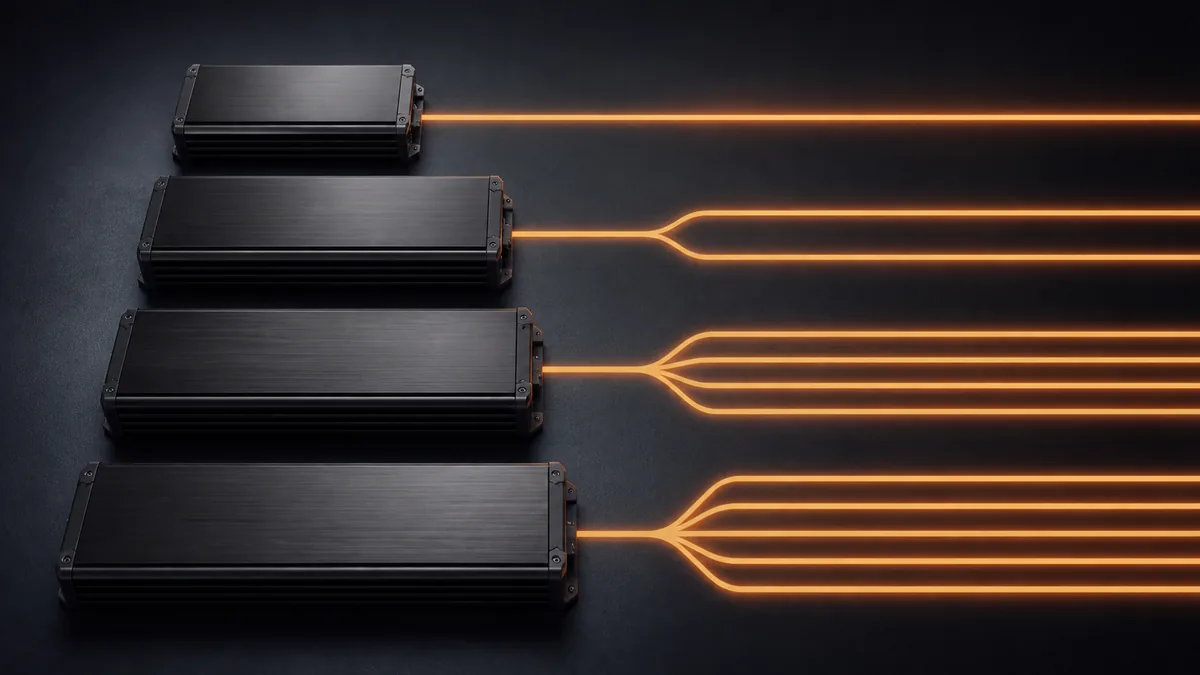
An amplifier channel is one independently handled audio-output path. Channel count describes the amplifier’s routing architecture; it does not tell you the complete power, load, filtering, or bridging capability.
Common channel layouts
| Amplifier layout | Independent output paths | Common system role | What still needs the manual |
|---|---|---|---|
| Mono / 1-channel | 1 | A dedicated subwoofer path or another mono role | Supported load, filtering, and number of drivers |
| 2-channel | 2 | One stereo pair | Whether and how bridging is supported |
| 4-channel | 4 | Front and rear stereo pairs, or other four-path designs | Per-channel modes, inputs, filters, and bridge pairs |
| 5-channel | Usually 5 | Four full-range paths plus a dedicated bass path | Power and load ratings for each section |
| 6–8+ channel | 6–8 or more | Multiway active systems and complex factory integration | DSP routing, channel assignment, and per-output limits |
Crutchfield’s amplifier-channel overview shows the common mono, two-, four-, and five-channel roles. These are useful patterns, not guarantees that every amplifier with the same channel count supports the same configuration.
Channel count is not speaker count
One channel can sometimes feed more than one driver, and one apparent speaker location can contain multiple drivers. Whether either arrangement is appropriate depends on topology, impedance, filtering, power distribution, and the amplifier documentation.
Therefore, “four speakers need four channels” is a useful starting map, not a universal wiring rule.
Mono and stereo describe different things
Mono/stereo describes signal-channel content. Amplifier channel count describes available output paths. A multichannel amplifier can receive, route, or sum signals in ways defined by its controls and internal design.
Read mono versus stereo for the signal distinction before treating the number of terminals as the number of unique audio channels.
Bridging is a mode, not ordinary combining
Some two- and four-channel amplifiers support bridged operation. JBL’s GX-A602 product documentation, for example, explicitly lists two-channel and bridged-mono capability for that model.
That example does not authorize bridging another amplifier. Approved terminal pairs, minimum load, input routing, and output rating are model-specific. A bridge connection is therefore excluded from this general channel-count guide.
Inputs and outputs may not have the same count
An amplifier can provide input switches, summing, pass-through outputs, DSP routing, or internally linked mono inputs. Two RCA sockets do not necessarily mean two independent amplified outputs, and five outputs do not necessarily require five unrelated source cables.
Follow the exact block diagram and input-mode instructions in the applicable manual.
A planning sequence that avoids assumptions
Before choosing channel count, identify:
- the number of independent signal bands or zones the design needs;
- whether each path is mono or part of a stereo pair;
- which drivers share passive networks and which need separate active channels;
- the documented output and load limits for each amplifier section;
- whether future expansion matters enough to reserve channels.
This page stops before compatibility or wiring. Those decisions belong to a risk-gated system-design process.
Last verified: August 22, 2026.
Sources
- Crutchfield, Car amplifier channels.
- JBL, GX-A602 2-channel car amplifier.