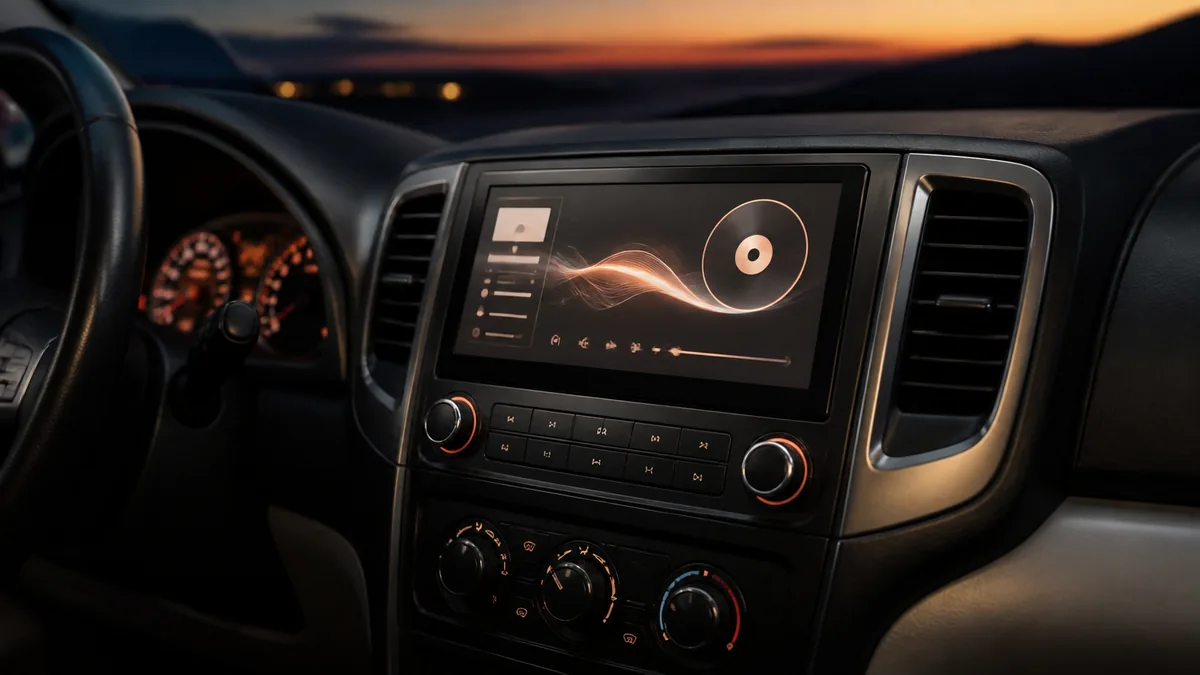
A head unit is the main user-facing source and control device in a vehicle audio system. It commonly selects audio sources and controls playback and volume. Depending on the vehicle or product, it may also handle navigation, phone integration, display functions, signal processing, and speaker amplification.
“Head unit” describes a role, not a guarantee that every relevant audio function lives in one removable box.
Why it has several names
| Term | Common meaning | Important limitation |
|---|---|---|
| Car radio | The dashboard radio/source unit | Modern units may do much more than receive radio |
| Car stereo | Often the head unit; sometimes the entire sound system | Context determines whether speakers and amplifiers are included |
| Receiver | A source/control unit with radio reception | Does not describe every input, output, or integration feature |
| Deck | Informal aftermarket term for an in-dash unit | Says little about current functionality |
| Infotainment system | Integrated information, connectivity, and entertainment interface | Audio processing or amplification may live in other modules |
These are overlapping user terms, not reasons to create separate definitions or pages. When discussing the component itself, Car Audio Atlas uses head unit. When a user says “radio” or “stereo,” the surrounding task determines whether they mean the head unit or the whole system.
Its core jobs
Texas Instruments describes the head unit as a central infotainment component that receives audio from sources such as smartphones and radio, processes it, and sends it toward amplification in its 2025 automotive-audio overview.
The exact product may perform several jobs:
- Source selection: choose radio, phone, USB, stored media, or another supported input.
- User control: manage playback, volume, balance, fader, and available sound controls.
- Decoding and conversion: turn stored or transported audio into a usable signal and convert between digital and analog representations where required.
- Signal output: send audio to an internal amplifier, external amplifier, processor, or factory network.
- System integration: display vehicle information or participate in cameras, steering-wheel controls, calls, prompts, and settings when designed to do so.
Edmunds’ head-unit overview likewise identifies source selection, playback control, volume, signal processing, and small built-in amplification as common functions. Its media examples reflect the era in which it was written, but the functional distinctions remain useful.
A head unit may contain an amplifier
Many factory and aftermarket head units contain power-amplifier channels that can drive speakers. A system with a head unit and speakers therefore still has amplification even when no separate amplifier chassis is visible.
Another system may send a lower-level signal or digital data to a separate factory or aftermarket amplifier. The external amplifier can also contain DSP. The product layout changes, but the functional signal path still includes source, control/processing, amplification, and loudspeakers.
Factory head units can be distributed systems
In a modern vehicle, the display, controls, tuner, media interface, DSP, amplifier, microphones, and network connections may be split among several modules. Audio can also carry information beyond music, including calls, navigation prompts, warning chimes, and other vehicle sounds.
That creates three practical boundaries:
- a screen in the dashboard is not proof that all audio hardware sits behind it;
- an aftermarket unit fitting the opening does not prove all factory functions will remain;
- an audio output being present does not identify its level, processing, channel content, or compatibility.
Those questions are vehicle- and product-specific. They require exact documentation and are outside this introductory concept page.
Built-in features vary
A product may advertise Bluetooth, smartphone projection, digital radio, USB playback, preamp outputs, equalization, crossovers, time alignment, camera inputs, or steering-wheel-control compatibility. None of those features belongs to every head unit.
Even the same model family can behave differently by market, firmware, connection type, or vehicle interface. Use the exact manual and compatibility documentation rather than treating a feature list as a definition of “head unit.”
What a head unit does not decide by itself
The head unit label alone does not tell you:
- whether its outputs are analog, digital, line level, or speaker level;
- how many independent audio channels exist;
- whether factory equalization or volume-dependent processing is present;
- whether it can safely drive a particular speaker load;
- whether a vehicle’s chimes, cameras, controls, microphones, or settings can be retained;
- whether replacing it will improve sound quality.
Those are configuration and compatibility questions, not definitions.
Where it sits in the learning path
Use the components map to distinguish the head unit from processors and amplifiers. Then follow the signal-path guide to see where conversion and amplification may occur.
Last verified: August 22, 2026.