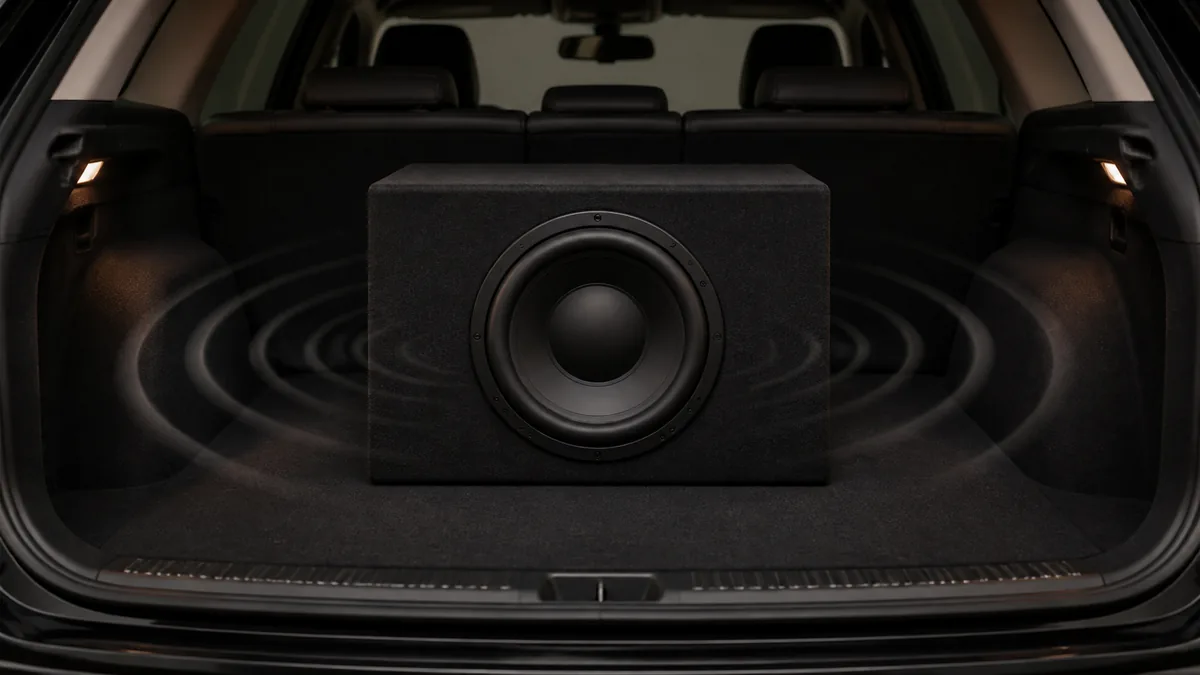
A car-audio subwoofer is a loudspeaker driver intended to reproduce the system’s lowest frequency region. It extends low-frequency capability and can reduce the amount of deep-bass work assigned to smaller speakers when the system is filtered accordingly.
A subwoofer is not a complete result by itself. The driver, enclosure or mounting arrangement, amplifier, filters, signal, installation, and vehicle cabin operate as one low-frequency system.
Subwoofer versus woofer
The terms overlap in casual use. A woofer handles a lower part of the audio range relative to a midrange or tweeter. A subwoofer is intended for the lowest system region below the main woofer or full-range speaker’s useful range.
There is no universal frequency that changes every woofer into a subwoofer. Product bandwidth, system filtering, acoustic output, and application define the role. The Crutchfield speaker glossary likewise treats woofer and subwoofer as functional driver terms rather than one fixed cutoff.
What determines the result
| System part | Its contribution | What it does not guarantee alone |
|---|---|---|
| Subwoofer driver | Converts the amplified low-frequency waveform into motion and sound | Extension, output, or durability in any enclosure |
| Enclosure or mounting | Provides acoustic loading and controls how the rear radiation interacts | A universal “tight” or “loud” sound from a box label |
| Amplifier | Supplies a higher-power waveform within its operating limits | Clean output, compatible load, or correct level merely from a wattage label |
| Low-pass filtering | Limits higher-frequency content sent to the subwoofer path | Correct integration with the main speakers |
| Main-speaker high-pass filtering | Can reduce deep-bass demand on smaller speakers | More output if other system limits remain |
| Vehicle cabin | Changes measured and perceived low-frequency response | The same result in every vehicle or seat |
Crutchfield’s overview of what subwoofers are presents the driver as part of a system that also requires suitable enclosure and amplification. Product-specific requirements still come from the applicable manual and data.
Raw driver, loaded enclosure, and powered subwoofer
A subwoofer can be sold in several forms:
- a raw driver that requires a suitable mounting arrangement or enclosure;
- a driver already installed in a sealed, ported, or other enclosure;
- a powered subwoofer combining driver, enclosure, and amplifier;
- a vehicle-specific assembly designed for a defined location;
- an infinite-baffle/free-air driver intended for an appropriate separating baffle and air volume.
These forms change packaging and system boundaries. They do not eliminate the need to verify signal input, electrical supply, controls, fit, ventilation, and product limits.
Why a separate amplifier is common
Producing low-frequency output can require substantial cone motion and electrical power. Many systems therefore use a dedicated or shared external amplifier channel rather than asking a head unit’s small internal amplifier to drive the subwoofer system.
The general amplifier job is to reproduce an input waveform at a higher power level; the Analog Devices amplifier overview explains why efficiency and heat are important design concerns. That does not establish which amplifier is compatible with a particular subwoofer.
Read what a car-audio amplifier does before treating an advertised power number as a matching rule.
Why subwoofers are often mono-fed
Many systems combine left and right low-frequency program content into one mono-derived subwoofer path. The main system can remain stereo while the lowest region is reproduced by one channel or group of subwoofers.
This is a routing choice, not permission to connect amplifier outputs together. Signal summing and speaker wiring are separate technical operations that require supported hardware and validated configurations.
What adding a subwoofer can and cannot do
A correctly integrated subwoofer can extend usable low-frequency reproduction, increase available low-frequency output, and allow the main speakers to work over a more suitable bandwidth.
It cannot automatically:
- restore bass removed or canceled upstream;
- correct clipping, noise, or faulty routing;
- make an unsuitable enclosure appropriate;
- guarantee smooth response at every seat;
- prove amplifier compatibility;
- prevent rattles or panel vibration;
- replace crossover, level, polarity, and measurement work.
“More bass” is also not one goal. Extension, maximum output, transient behavior, seat-to-seat consistency, packaging, and tonal balance can trade against one another.
Questions before choosing hardware
Start with the user job rather than a diameter or wattage number:
- What low-frequency range and listening level are required?
- How much enclosure and mounting space is actually available?
- Which enclosure types and volumes does the driver documentation support?
- What input signal and processing are available?
- How will amplifier load and power compatibility be verified?
- Which seats matter, and how will the result be measured?
The subwoofer enclosure types map explains the major loading categories without prescribing dimensions. Installation, load wiring, and amplifier matching remain separate higher-risk procedures.
Last verified: August 22, 2026.
Sources
- Crutchfield, Car speakers glossary.
- Crutchfield, What are subwoofers?.
- Analog Devices, Class D Audio Amplifiers: What, Why, and How.