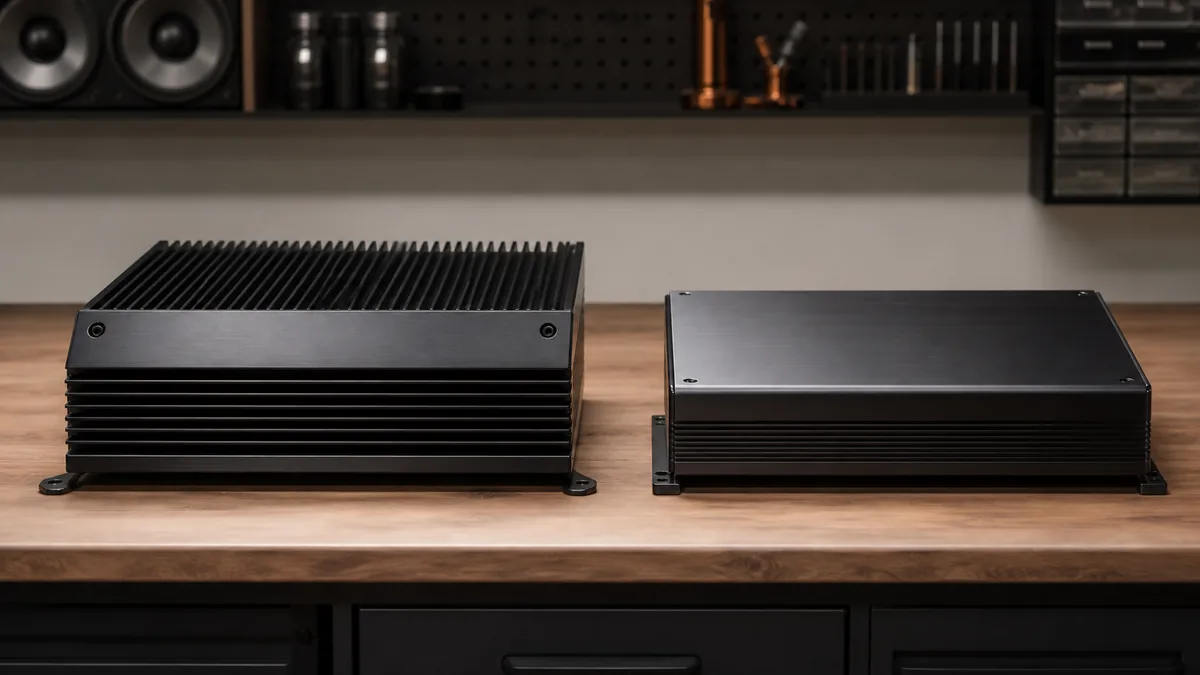
Class AB and Class D describe different power-amplifier output-stage approaches. They influence efficiency, heat, circuit design, and packaging, but the class letter alone does not establish sound quality, reliability, output power, or suitability for a particular car-audio system.
Compare complete products under documented conditions, not stereotypes about their topology.
The short distinction
A Class AB output stage uses active devices that conduct over overlapping portions of the waveform. It is a linear amplification approach: the output devices dissipate the difference between supplied and delivered power as heat.
A Class D output stage switches devices between states and reconstructs the audio output through the circuit and output filtering. The “D” is a class designation, not a claim that the signal is digital. A Class D amplifier can accept an analog signal.
The Analog Devices Class D overview explains the switching operation, output filtering, power loss, and distortion considerations in more detail.
Practical comparison
| Attribute | Class AB tendency | Class D tendency | Why the individual product still matters |
|---|---|---|---|
| Efficiency | More power commonly dissipated in the output stage | Switching operation commonly reduces output-stage loss | Idle behavior, load, power level, supply design, and test method change the result |
| Heat | Often requires more heat-sink area for a comparable task | Often enables less heat and smaller cooling hardware | Chassis design, airflow, installation, and protection determine actual temperature |
| Packaging | May be larger for a given rated output | Can provide high output in a compact chassis | Channel count, power supply, connectors, and thermal targets also set size |
| Output filtering | No Class D switching-output filter requirement | Commonly uses an output filter and must control switching artifacts | Filter design and load interaction vary by implementation |
| Measured performance | Can be excellent or poor | Can be excellent or poor | Noise, distortion, bandwidth, load behavior, and protection must be measured |
| Application | Used for full-range and other channels | Used for subwoofer and full-range channels | The product’s specified bandwidth and capabilities decide the role |
These are design tendencies, not purchase verdicts.
Is Class D only for subwoofers?
No. Earlier or lower-cost designs may have reinforced that association, but modern Class D amplifiers can be designed for full-range use. The relevant evidence is the amplifier’s documented bandwidth, distortion, noise, load capability, output, and behavior in the intended configuration.
Likewise, a Class AB label does not prove that a product has wider bandwidth or lower audible distortion. Topology is one input to the design, not the complete result.
Does Class AB always sound better?
No universal engineering rule supports that claim. Audible performance depends on the complete amplifier, its operating conditions, system gain structure, speakers, installation, processing, and listening level.
A fair comparison should control level and avoid clipping. Small loudness differences can be mistaken for quality differences, while an amplifier operated beyond its linear range is not being compared on equal terms.
Read audio clipping for the distinction between topology and an exceeded output boundary.
Efficiency is not one fixed number
An efficiency figure is meaningful only with its test conditions. It can change with output level, load, supply voltage, channel usage, frequency, and measurement method. A high peak figure does not state idle draw, low-level behavior, thermal performance, or total vehicle electrical demand.
The same caution applies to power. CTA’s 12-volt amplifier explanation describes how compliant output claims depend on defined voltage, load, frequency, and distortion conditions. Class AB and Class D ratings should be compared using compatible methods.
What the class does not tell you
The label alone does not establish:
- how much continuous power the amplifier produces under the intended conditions;
- whether it supports a particular nominal load or bridged mode;
- its input options, crossover controls, DSP, or signal compatibility;
- idle current, noise, thermal limits, or protection behavior;
- physical fit, cooling clearance, or connector quality;
- reliability or warranty support;
- audible transparency in a controlled comparison.
Those are product-level questions.
A better selection sequence
- Define channel count, signal inputs, processing, and intended speaker loads.
- Compare continuous output using compatible published test conditions.
- Check bandwidth, noise, distortion, protection, and control requirements.
- Evaluate efficiency, heat, chassis size, and vehicle electrical constraints.
- Verify installation and load limits in the exact product manual.
- Treat amplifier class as one design attribute, not the deciding score.
Use RMS versus peak power when evaluating the rating language attached to either class.
Last verified: August 22, 2026.
Sources
- Analog Devices, Class D Audio Amplifiers: What, Why, and How.
- Consumer Technology Association, 12 Volt Amplifiers.