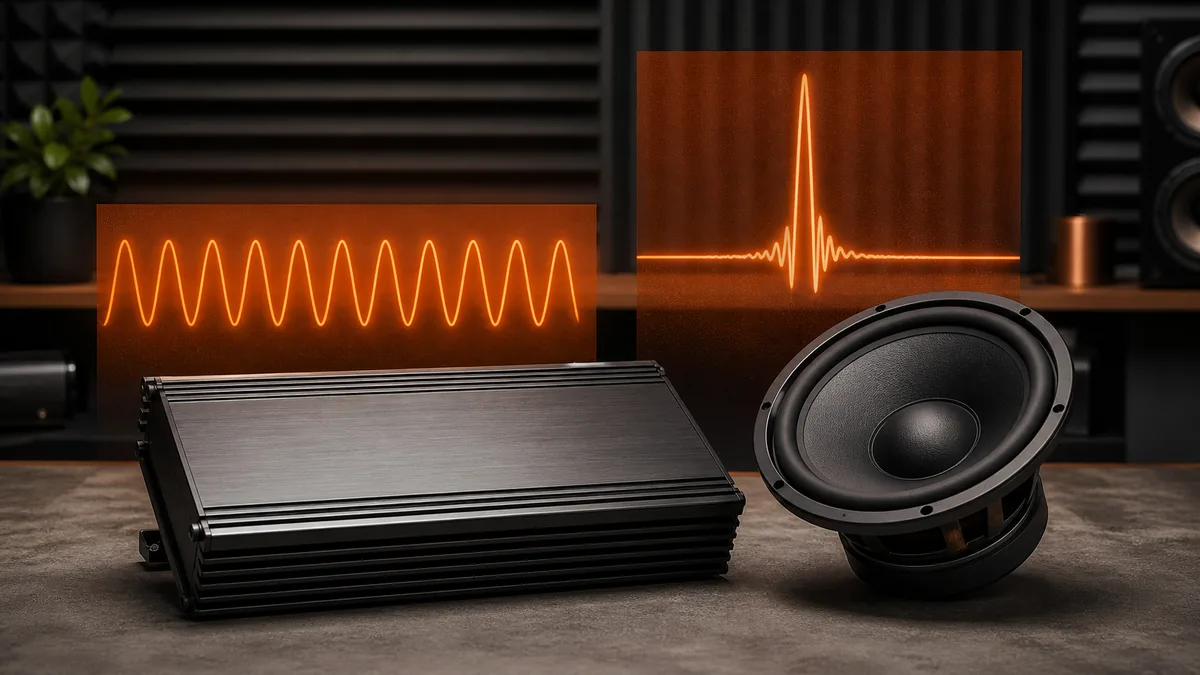
Car-audio products commonly advertise RMS, continuous, peak, or maximum watts. Those words are not interchangeable, and a wattage number without its measurement method is incomplete.
For comparison and system planning, prefer a continuous rating tied to documented conditions. Do not match an amplifier’s peak claim to a speaker’s continuous rating or assume two “RMS” labels were produced by the same test.
Start with what watts describe
A watt is a unit of power. In audio, voltage and current vary with the signal, load, frequency, and time. A power rating summarizes performance under defined test conditions; it is not a permanent amount of power that music continuously “pushes” into a speaker.
The term RMS power is common market language. Strictly, RMS is an averaging method applied to quantities such as voltage or current. Power is then calculated or averaged under the defined method. Car Audio Atlas acknowledges the user term while preferring continuous power rating when the test actually supports it.
Rating labels and evidence
| Label | What it may intend to communicate | Evidence needed before comparison |
|---|---|---|
| Continuous power | Sustained output or handling under a defined procedure | Duration, load, frequency/bandwidth, distortion limit, supply condition, channels driven, thermal conditions |
| “RMS watts” | Often used as shorthand for a continuous rating | The actual standard or manufacturer method; the label alone is insufficient |
| Peak power | Short-duration capability under a stated definition | Peak duration, waveform, load, voltage limit, and whether the value is measured or calculated |
| Maximum/max power | Marketing or product-specific maximum | A clear definition; otherwise it should not be compared numerically |
| Dynamic/burst power | Output during a specified short test signal | Burst length, duty cycle, supply behavior, load, and distortion/clip criterion |
The Consumer Technology Association’s ANSI/CTA-2006-D listing identifies a defined measurement standard for in-vehicle audio amplifiers. CTA’s public 12-volt amplifier explanation also emphasizes that a compliant power claim depends on stated test conditions rather than the largest number printed on packaging.
Amplifier ratings need conditions
An amplifier can produce different measured output depending on:
- supply voltage and its ability to remain stable;
- load impedance and channel configuration;
- number of channels driven;
- test frequency or bandwidth;
- distortion or clipping threshold;
- duration and thermal state;
- protection or limiting behavior.
Therefore, “500 W amplifier” is not a complete specification. It should become a statement such as a documented continuous output per channel into a stated load, at a stated supply and distortion criterion.
Speaker ratings describe a different boundary
A loudspeaker power-handling rating concerns what the driver or system can withstand under its defined test. It is not a promise of loudness, bass extension, or immunity to damage from every waveform.
The AES2 loudspeaker standard listing is an example of formal loudspeaker measurement scope. A speaker manufacturer’s applicable method, bandwidth, enclosure, filtering, and duration still matter.
Amplifier output and speaker power handling are therefore not two identical numbers waiting to be made equal. They describe different devices and test boundaries.
Why peak-to-continuous ratios are unreliable
There is no universal divisor that converts every “max” or “peak” claim into a valid continuous rating. Dividing by two, four, or another fixed number can accidentally resemble one product’s relationship while failing for another definition.
If the peak label has no method, mark it UNAVAILABLE for technical comparison. Use the documented continuous specifications instead.
More watts do not directly equal proportionally more loudness
Acoustic output depends on speaker sensitivity, power compression, bandwidth, enclosure or mounting, number of drivers, distance, cabin behavior, distortion limits, and available clean amplifier output. Power ratios also map logarithmically to decibels, not linearly to perceived loudness.
Read speaker sensitivity and decibels in car audio before turning a wattage ratio into a loudness prediction.
Continuous ratings do not guarantee compatibility
Even two credible continuous ratings are not a complete matching method. Compatibility can depend on:
- nominal and frequency-dependent load behavior;
- amplifier channel and bridge mode;
- speaker wiring topology;
- required bandwidth and filters;
- source and gain structure;
- enclosure and thermal conditions;
- manufacturer limits and intended use.
Those checks belong to a separately validated system-design process. This reference page does not recommend an amplifier-to-speaker power ratio.
A trustworthy reading order
When a specification sheet presents several wattage numbers:
- Find the applicable standard or test method.
- Separate continuous, peak, burst, and undefined maximum claims.
- Record load, channels, supply voltage, bandwidth/frequency, and distortion criterion.
- Compare only ratings with compatible definitions and conditions.
- Treat missing conditions as uncertainty.
- Check clipping and protection behavior separately from the printed power claim.
Continue with audio clipping to understand why the usable output boundary depends on waveform behavior, not just a label.
Last verified: August 22, 2026.
Sources
- Consumer Technology Association, ANSI/CTA-2006-D.
- Consumer Technology Association, 12 Volt Amplifiers.
- Audio Engineering Society, AES2 loudspeaker measurement standard listing.