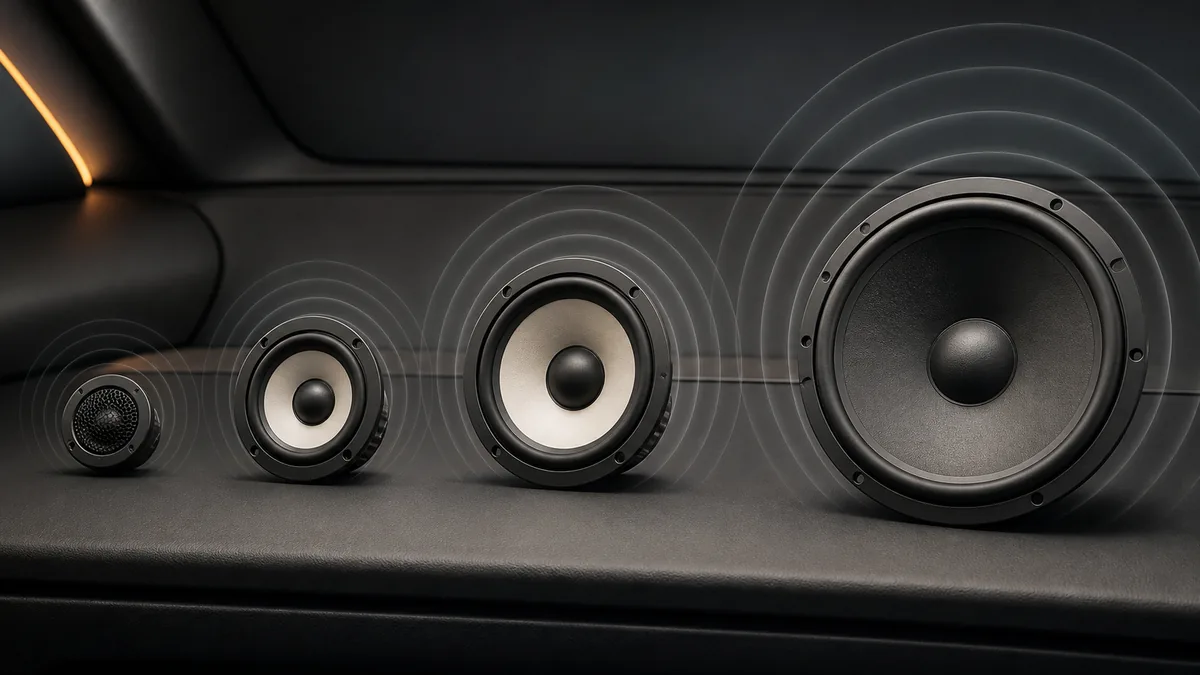
Frequency describes how often a periodic event repeats. For audio, it describes the repetition rate of a waveform and is written in hertz (Hz). One hertz is one cycle per second; the NIST SI guide identifies hertz as the derived SI unit for frequency, equivalent to reciprocal seconds.
Frequency helps describe where a sound sits from low to high. It does not, by itself, tell you how loud, clean, or pleasant that sound will be.
Frequency and pitch are related, not identical
For a simple steady tone, a higher fundamental frequency is generally perceived as a higher pitch. Music and real-world sounds are more complex: they contain fundamentals, harmonics, changes over time, and noise-like components. The ear and brain interpret that complete pattern rather than reading one number.
That distinction matters in car audio. A vocalist, guitar, or drum cannot be assigned to one fixed frequency. Each can produce energy across a range, and its recognizable character depends on more than its fundamental note.
Why car-audio systems divide the frequency range
One loudspeaker driver is rarely ideal at reproducing every part of the audio range at the required level and dispersion. Systems therefore use different driver types and filter the signal into overlapping working regions.
| Driver name | General role | Important limitation |
|---|---|---|
| Tweeter | Higher-frequency reproduction | Its safe operating range is product-specific |
| Midrange driver | Middle region | The boundaries vary by design and system goal |
| Woofer | Lower and middle-low region | “Woofer” does not define one universal cutoff |
| Subwoofer | Lowest intended region | Cabin, enclosure, filter, and driver behavior all matter |
These names describe roles, not exact universal bands. The correct operating range comes from the driver’s data and the system design. Crutchfield’s speaker glossary likewise distinguishes tweeter, midrange, woofer, and crossover roles without making every product identical.
Frequency response is more than two endpoints
A specification written as “X Hz–Y kHz” gives boundaries under some test conditions, but the endpoints do not reveal everything important. A useful frequency-response statement also depends on:
- how much level variation is allowed;
- the measurement environment and distance;
- whether the result is on-axis or off-axis;
- whether smoothing is applied;
- which filters, enclosure, and loading conditions are present.
Two products can list similar endpoints and behave differently between them. Without tolerances and test conditions, an impressive-looking range is incomplete evidence.
Frequency is not volume
A waveform can keep the same frequency while its amplitude changes. The perceived pitch can remain broadly the same while the level rises or falls. Conversely, two frequencies played at the same measured electrical level may not seem equally loud because the loudspeaker, cabin, and human hearing are frequency-dependent.
This is one reason a flat-looking electrical signal does not guarantee flat acoustic output at the listener.
Frequency appears throughout the signal path
Frequency is used to describe several different things:
- the content of the music or test signal;
- a source’s or component’s bandwidth;
- a loudspeaker’s measured response;
- a crossover or equalizer control;
- a noise component found during diagnosis;
- the sampling rate of digital audio, which is a different use of hertz.
Do not confuse audio frequency with digital sample rate. Audio frequency describes components within the represented signal. Sample rate describes how many digital samples are taken per second. Analog Devices’ sampling-rate definition explains this distinction and the role of sampling criteria.
What varies inside a vehicle
The cabin adds reflections, absorption, path-length differences, and position-dependent reinforcement or cancellation. Moving a measurement microphone—or just moving your head—can change measured response, especially at shorter wavelengths and around strong interference patterns.
That does not make frequency response meaningless. It means the measurement must be interpreted with its location, method, and purpose.
Practical reading rules
When you encounter a frequency number, ask:
- Is it describing a tone, a filter, a sample rate, or a measured response?
- What unit and scale are used?
- What tolerance or reference accompanies the number?
- Under what conditions was it measured?
- Is it a product-specific limit or only a general example?
Those questions prevent a common mistake: treating one isolated number as a complete prediction of sound quality.
Related concepts
Learn next why a decibel is a ratio that needs context, how loudspeakers divide the work, and where frequency-dependent processing appears in the signal path.
Last verified: August 22, 2026.
Sources
- NIST, Guide for the Use of the International System of Units (SI).
- Analog Devices, Class D Audio Amplifiers: What, Why, and How.
- Crutchfield, Car speakers glossary.