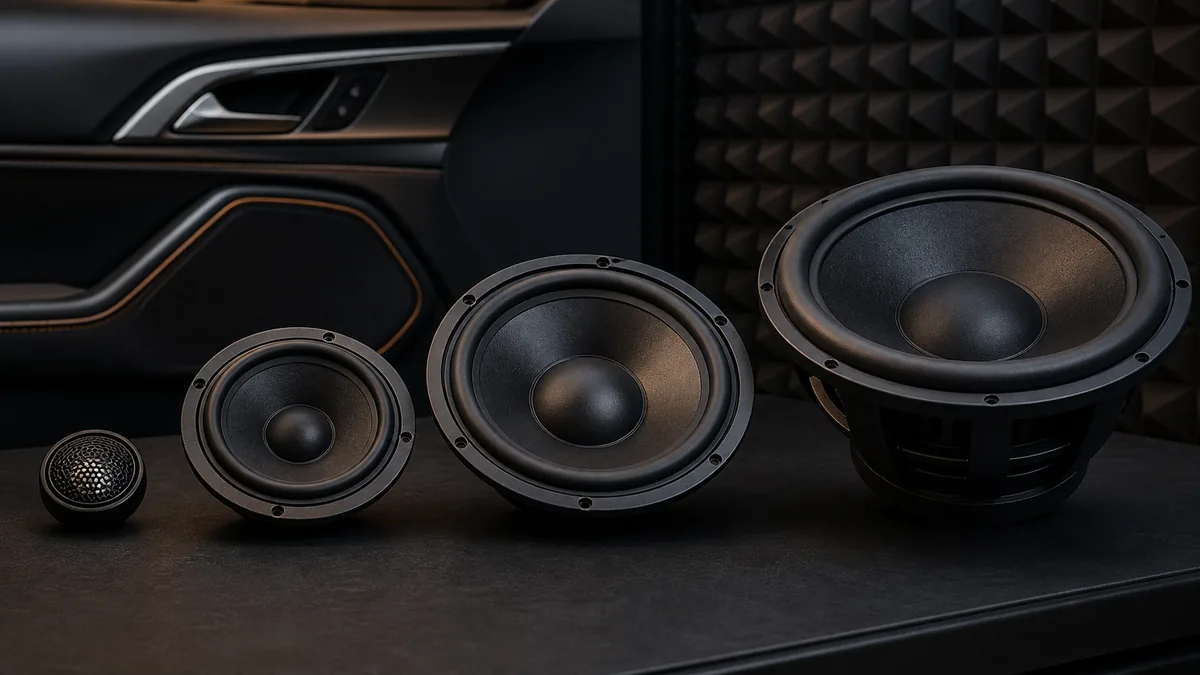
A car speaker is an electroacoustic transducer. It receives an electrical audio signal, creates mechanical motion, and produces changing acoustic pressure that reaches the listener as sound.
“Speaker” can mean one driver, a coaxial assembly containing several drivers, a component set, or a complete enclosure. Identifying which meaning is intended prevents confusion.
From amplifier output to acoustic output
A conventional moving-coil loudspeaker driver contains a voice coil in a magnetic field, a diaphragm or cone, suspension parts that guide motion, and a frame that holds the assembly. The amplifier’s changing output produces force on the coil. The attached diaphragm moves and interacts with the surrounding air.
This conversion is not perfect. Some electrical input becomes heat, mechanical parts have limits, and output varies with frequency, direction, enclosure, mounting, and environment. The Analog Devices amplifier overview frames the amplifier’s role as reproducing the input signal at sound-producing output elements with the required power and controlled distortion.
Driver names describe roles
| Driver | General role | What the name does not guarantee |
|---|---|---|
| Tweeter | Reproduces higher frequencies | One universal cutoff or dispersion pattern |
| Midrange | Reproduces a middle frequency region | Identical bandwidth across products |
| Woofer | Reproduces lower and middle-low frequencies | Deep sub-bass in every mounting location |
| Subwoofer | Reproduces the lowest intended system region | A particular enclosure, output, or extension |
These regions overlap by design. A crossover manages the transition; the labels alone do not specify safe filter settings.
Coaxial and component are arrangements
A coaxial or full-range car speaker places multiple drivers in one physical assembly, commonly with a tweeter positioned near the woofer’s axis. A component set separates drivers physically and normally includes or requires a crossover arrangement.
The arrangement affects installation flexibility and acoustic geometry. It does not make every component system better than every coaxial system. Driver design, crossover behavior, placement, mounting, power limits, tuning, and goals all matter.
Crutchfield’s speaker glossary documents these common industry terms, while its component-system overview shows the usual woofer, tweeter, and crossover functions. Product manuals remain the authority for a particular set.
Why crossovers exist
A crossover changes signal level by frequency so different drivers receive intended portions of the program. It can be:
- passive, operating after power amplification;
- active, operating before the final power-amplifier stage;
- implemented inside a receiver, DSP, or amplifier;
- built into a speaker assembly or supplied as a separate network.
A crossover is not a brick wall. Real filters transition over frequency, and adjacent drivers often overlap. Filter type, slope, phase behavior, driver response, and placement affect how the outputs combine.
This page does not prescribe crossover frequencies. Those settings are system- and product-specific and can carry equipment-damage risk.
Mounting becomes part of the acoustic system
A driver does not operate independently of its surroundings. A door cavity, dash location, factory grille, baffle, enclosure, leakage path, and nearby surfaces can change response and output.
The cabin also creates unequal distances and reflections. A measurement made close to one driver is not the same as the combined response at a seat. This is why speaker specifications, installation quality, and in-vehicle measurement answer different questions.
Speaker size is not a complete performance specification
Diameter influences design possibilities, but size alone does not determine usable bandwidth, output, sensitivity, distortion, or sound quality. Two drivers of the same nominal size can have different moving assemblies, motors, suspension, thermal limits, intended enclosures, and frequency ranges.
Likewise, the number of “ways” describes how many driver sections a manufacturer identifies; it does not provide a universal measure of quality.
Four useful boundaries
Signal versus power: the waveform tells the driver how to move; amplifier output supplies the energy for that motion.
Driver versus system: a raw driver’s behavior differs from the result after crossover, mounting, enclosure, cabin, and listening position.
Nominal label versus measurement: product labels summarize; measured response shows behavior under stated conditions.
General role versus safe operation: knowing that a tweeter handles high frequencies does not establish the correct filter for a specific tweeter.
Continue with audio frequency for the vocabulary behind driver ranges and the signal path for the stages before the speaker.
Last verified: August 22, 2026.
Sources
- Analog Devices, Class D Audio Amplifiers: What, Why, and How.
- Crutchfield, Car speakers glossary.
- Crutchfield, Component speakers installation guide.