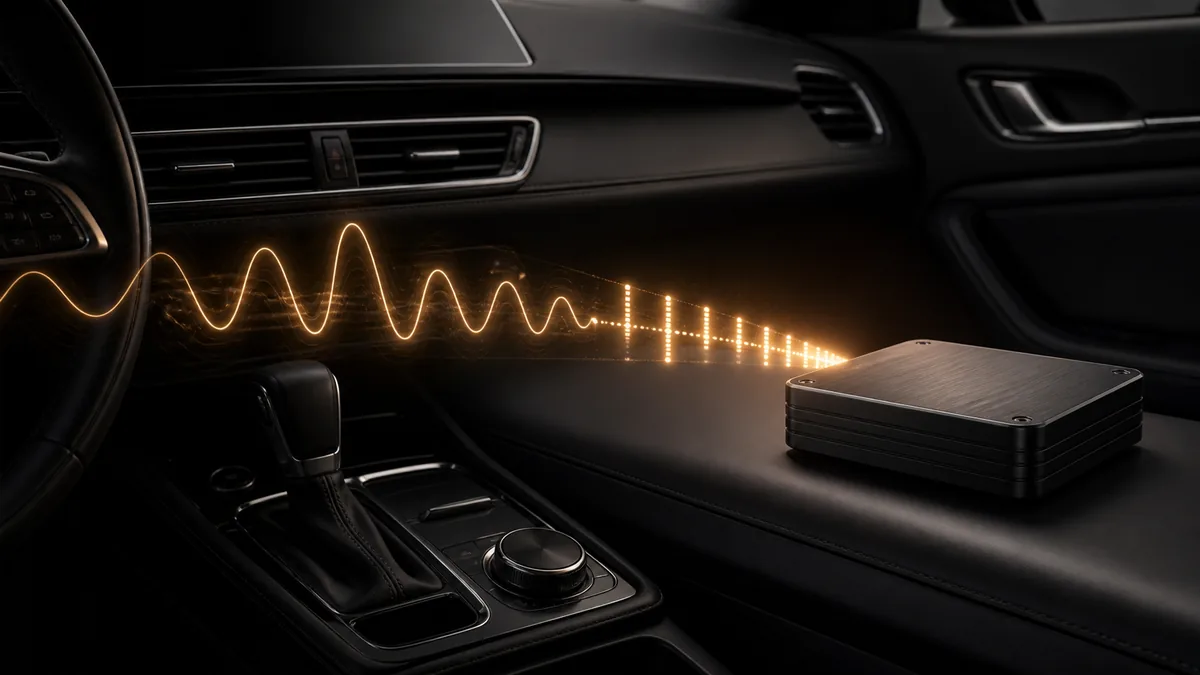
An analog audio signal varies continuously with time. Digital audio represents a signal as numerical data sampled and quantized according to a defined system. A modern car-audio path may use both.
Neither label is a complete quality rating. Results depend on implementation, signal level, conversion, processing, noise, bandwidth, and every downstream stage.
The path can change representation
A phone may store compressed digital audio, decode it to digital samples, and send those samples to a receiver. The receiver may process them digitally, convert them to analog, and feed an amplifier. A different system may convert a factory analog output back to digital for DSP, then convert it to analog again before power amplification.
Analog Devices describes this general process in its beginner’s DSP guide: an analog-to-digital converter (ADC) can digitize a real-world signal, a DSP can manipulate the data, and a digital-to-analog converter (DAC) can return it to analog form for output.
The existence of several conversions does not by itself prove that the system is poor. The design and operating conditions of each stage matter.
What an analog signal carries
In a conventional analog connection, instantaneous electrical variation represents the waveform. The receiving input must be compatible with the signal’s level, reference, bandwidth, and source characteristics.
“Analog” does not mean “speaker level.” A low-level analog preamplifier signal and a power-amplified speaker output are both analog, but they are intended for different inputs.
Likewise, an RCA connector often carries analog audio in aftermarket systems, but the connector shape alone is not a complete electrical specification.
What digital audio carries
Digital audio uses numbers to represent sampled signal values. The data also needs structure: sample rate, word length or encoding, channel arrangement, framing, and a transport or storage format.
An ADC samples a continuous input and assigns a digital code to each sample. Analog Devices’ ADC definition notes that finite codes introduce quantization error. The sampling-rate definition distinguishes samples per second from the audio frequencies represented by those samples.
A cable carrying digital data is not universally compatible with another digital input. Protocol, format, clocking, channel data, and product support must agree.
Digital processing is a function, not a sound signature
A DSP can implement volume control, equalization, filters, routing, delay, mixing, and other mathematical operations. Whether those operations help depends on their design and settings.
The word “digital” does not guarantee:
- flat frequency response;
- absence of clipping or noise;
- correct channel routing;
- high resolution at every stage;
- compatibility between two products;
- better acoustic results in the cabin.
Similarly, “analog” does not guarantee purity, warmth, or freedom from conversion elsewhere in the chain.
Why factory integration complicates the labels
A factory system may distribute digital data between modules yet expose only processed analog speaker outputs to an aftermarket installer. It may also vary output by volume, source, warning state, vehicle speed, or factory tuning.
Therefore, “tap the factory signal” is incomplete. The useful questions are:
- Where in the system is the signal available?
- Is it analog or a supported digital format?
- What level and channel content does it contain?
- What processing has already occurred?
- Does the receiving device explicitly support it?
Answers require vehicle and product documentation or measurement; generic connector labels are not enough.
Conversion terms worth keeping straight
| Term | Direction | Purpose |
|---|---|---|
| ADC | Analog to digital | Represent an analog input as numerical samples |
| DAC | Digital to analog | Reconstruct an analog output from digital samples |
| Codec | Encoding/decoding | Store or transport audio using a defined representation |
| DSP | Mathematical signal processing | Filter, route, mix, delay, analyze, or otherwise transform sample data |
A single integrated circuit or product may perform several of these roles.
A better comparison question
Instead of asking “is analog or digital better?”, ask which path preserves the required information with acceptable noise, distortion, latency, bandwidth, and compatibility for the specific system. That question can be tested and documented.
Use the signal-path guide to locate each conversion, and audio frequency to distinguish program bandwidth from sample rate.
Last verified: August 22, 2026.
Sources
- Analog Devices, A Beginner’s Guide to Digital Signal Processing.
- Analog Devices, ADC.
- Analog Devices, Sampling Rate.