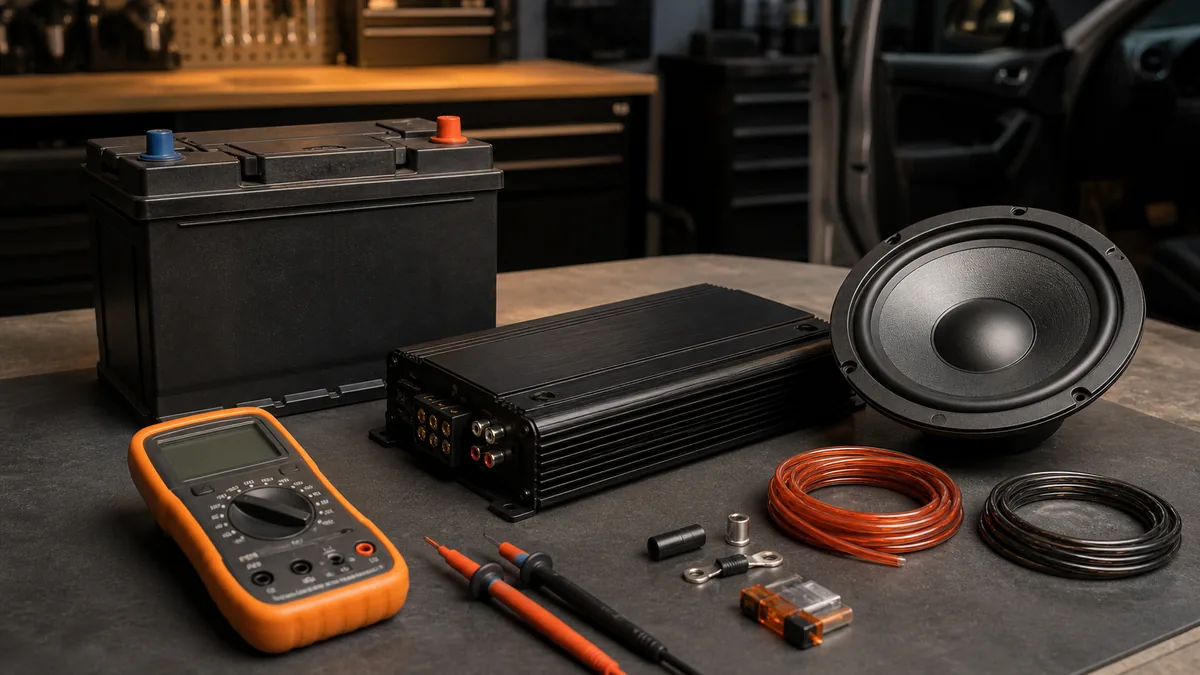
Voltage, current, resistance, impedance, and power describe different parts of the same electrical event. A car-audio component may list all five, but none of the numbers makes sense in isolation.
The five quantities at a glance
| Quantity | Unit | Symbol commonly seen | What it describes |
|---|---|---|---|
| Voltage | volt | V | Electric potential difference between two points |
| Current | ampere | A or I | Rate of electric charge flow |
| Resistance | ohm | Ω or R | Opposition to direct current in a resistive model |
| Impedance | ohm | Ω or Z | Frequency-dependent opposition in an alternating-signal system |
| Power | watt | W or P | Rate at which energy is transferred or converted |
The NIST guide to electric-current units gives the SI relationships behind the volt, ampere, and ohm. These are measurement definitions, not car-audio marketing categories.
Voltage is a difference, not a supply of watts
A voltage exists between two points. In a vehicle, people often shorten this to “12 volts,” but an actual measured value depends on the vehicle state, charging strategy, load, measurement points, and meter conditions.
That is why a voltage label alone does not tell you how much current a circuit will carry or how much power an amplifier will deliver.
Current is what flows through a path
Current is measured in amperes. The current in a circuit depends on the applied voltage and the opposition presented by the circuit. It is not a fixed amount that every connected device is forced to consume.
An amplifier’s music-dependent current draw is also not identical to a single continuous test-load number. Signal level, efficiency, load, supply behavior, and protection state all affect what happens in use.
Resistance and impedance are related but not interchangeable
Resistance is sufficient for a simple direct-current model. A loudspeaker receives an audio signal that changes over time, and its electrical opposition also changes with frequency. That broader behavior is impedance.
This is why an ohmmeter reading at direct current should not automatically replace the nominal impedance printed on a speaker. Read speaker impedance for that distinction.
Power connects voltage and current
Power is measured in watts. In a simple electrical model, the familiar relationships are:
- voltage equals current multiplied by resistance;
- power equals voltage multiplied by current;
- equivalent forms can be derived when the model and known quantities are appropriate.
NIST’s Ohm’s Law overview expresses current as I = V/R. Car-audio calculations add important boundaries: a loudspeaker is not a constant resistor, an amplifier has limits, and a vehicle supply is not an ideal fixed-voltage source.
One number cannot answer a system question
These common shortcuts fail because they discard necessary context:
- “More volts means more watts” ignores the load and circuit limits.
- “A speaker measures 3 Ω, so it is a 3-ohm speaker” confuses DC resistance with nominal impedance.
- “A 1,000-watt label means 1,000 watts at all times” ignores the test method and operating conditions.
- “The fuse rating is the normal current draw” confuses a protection boundary with a usage measurement.
For power-label context, continue with RMS versus peak power. For the vehicle sources behind the electrical system, read battery versus alternator.
Scope boundary
This page is a vocabulary and relationship map. It does not size wire or fuses, predict amplifier output, calculate a safe speaker load, or recommend a battery or alternator upgrade. Those tasks require additional inputs, applicable product documentation, and stronger validation.
Last verified: August 22, 2026.
Sources
- National Institute of Standards and Technology, SI Units – Electric Current.
- National Institute of Standards and Technology, Ampere: The Present.