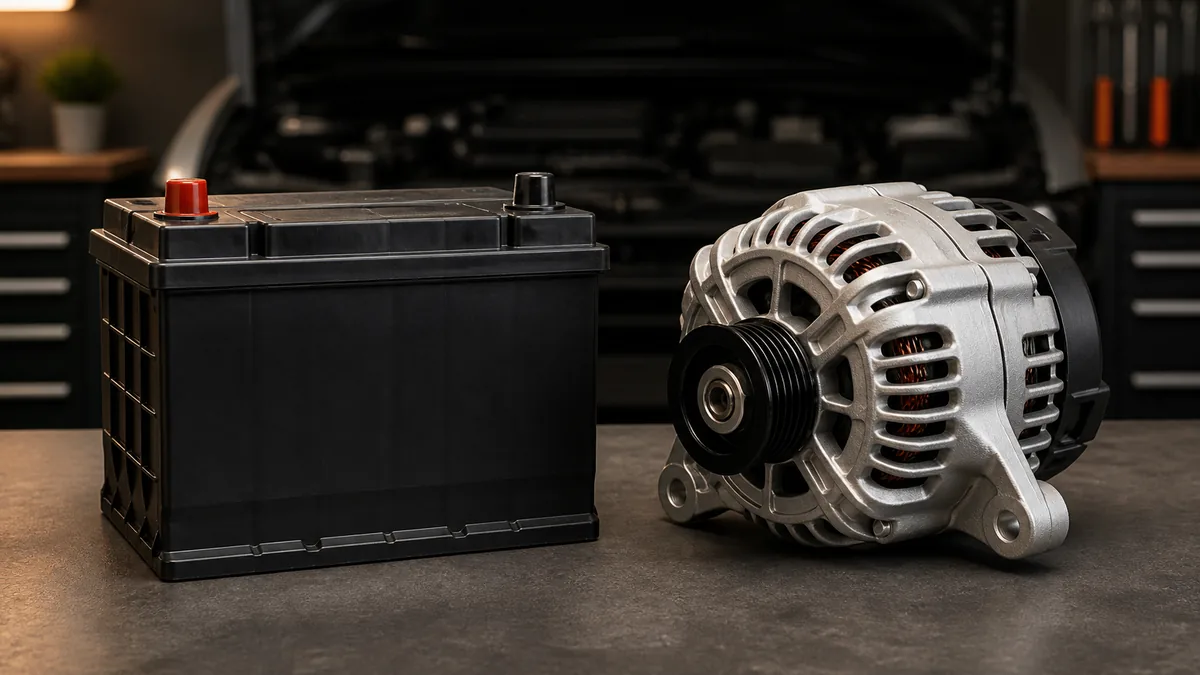
The battery and alternator are not interchangeable car-audio power upgrades. They have different roles inside one charging system, and their contribution changes with vehicle state and electrical demand.
Role by operating state
| Vehicle state | Battery’s primary role | Alternator’s primary role |
|---|---|---|
| Engine off | Stores and supplies electrical energy | Not being mechanically driven in a conventional belt-driven system |
| Engine starting | Supplies the starter and vehicle systems | Not yet providing normal running output |
| Engine running | Remains connected; can absorb charge or supplement demand | Converts mechanical energy and supplies vehicle loads while recharging the battery |
| Demand exceeds available alternator output | Supplies the temporary shortfall | Supplies what it can under the current speed, control, temperature, and system conditions |
DENSO’s alternator overview describes the alternator as an engine-driven converter that supplies vehicle loads and recharges the battery. It also states that the battery can provide extra power when required load and alternator output do not match.
What the regulator does
An alternator does not simply produce one unchanging voltage. Engine speed and operating conditions vary. DENSO’s technical manual explains that the regulator controls generated voltage so vehicle loads are supplied and the battery is charged appropriately.
Modern charging behavior can also depend on vehicle control strategies. Therefore, a universal “running voltage” copied from another car is not enough to diagnose a particular vehicle.
Why the battery still matters while driving
The simplified statement “the alternator powers everything when the engine runs” hides the shared nature of the system. The battery remains electrically connected. It can accept charging current, support temporary demand, and influence system behavior.
DENSO’s starter and alternator glossary defines the battery as an electrical storage device and the alternator as the device that maintains battery charge and vehicle electrical requirements. Those are complementary functions.
Why an amplifier watt label cannot choose an upgrade
An audio power rating does not directly state the vehicle’s continuous added electrical demand. A real assessment would need, among other things:
- the amplifier’s documented efficiency and test conditions;
- actual listening and test signal behavior;
- existing vehicle loads;
- charging output across operating conditions;
- battery condition and type;
- cable, connection, and voltage-drop measurements;
- the vehicle’s charging-control strategy.
Without those inputs, “buy a second battery” or “install a larger alternator” is a guess rather than a diagnosis.
Battery capacity is not alternator output
Battery capacity describes stored charge under defined conditions. Alternator current capability describes generation under defined conditions. Adding storage does not automatically create more sustained generation, and changing generation does not repair a weak battery or bad connection.
Keep these ratings separate from RMS and peak audio power, which describe another measurement boundary.
Scope and stop boundary
This is a functional comparison, not an upgrade or test procedure. Battery, alternator, belt, charging-wire, fuse, ground, and vehicle-control work can create safety and reliability risks. Diagnose the exact vehicle with its service information and qualified automotive support before modifying the charging system—especially on hybrid or electric vehicles.
Last verified: August 22, 2026.
Sources
- DENSO, Alternators: how alternators work.
- DENSO, Starter & Alternator Technical Manual.
- DENSO Auto Parts, Starter & Alternator glossary.