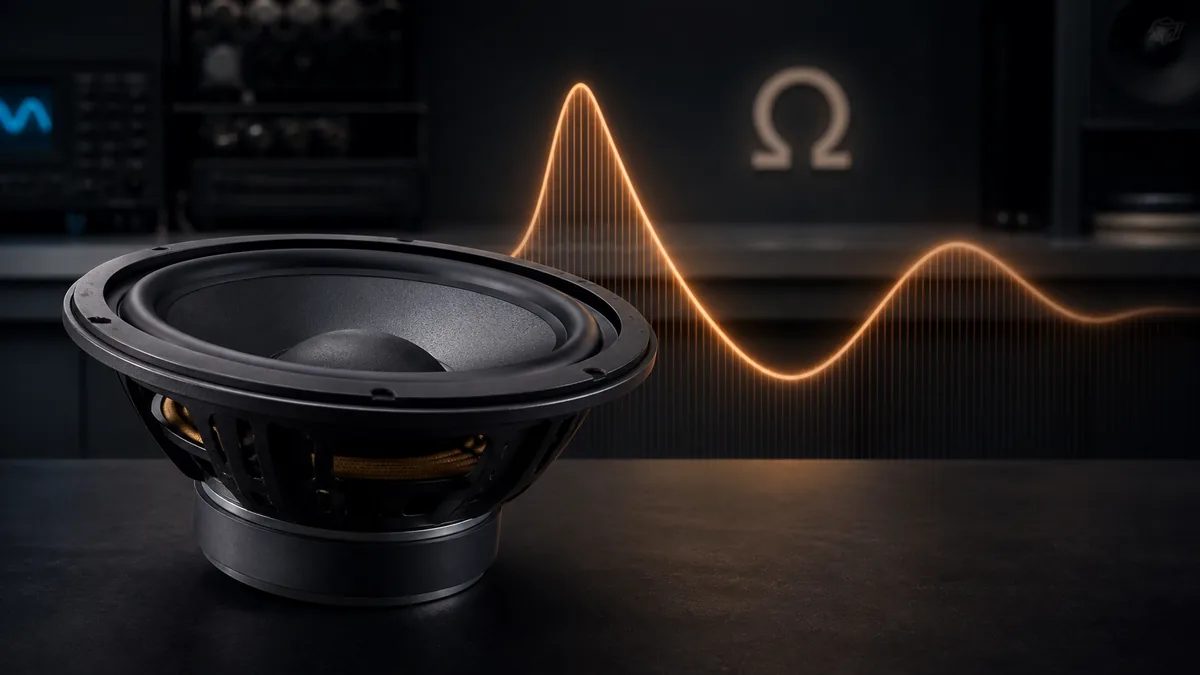
Speaker impedance is the opposition a loudspeaker presents to an audio signal. It is measured in ohms, but it is not usually one fixed resistance at every frequency.
Three values that people call “ohms”
| Value | What it represents | What it does not represent |
|---|---|---|
| Nominal impedance | A standardized or manufacturer-assigned reference rating for the driver/system | The exact load at every frequency |
| Impedance curve | Magnitude and phase behavior across frequency | One convenient number for a product label |
| DC resistance (DCR) | Voice-coil resistance measured at direct current | The complete audio-frequency load |
The SI unit is the ohm, as summarized by NIST. The important car-audio issue is not the unit itself; it is which electrical quantity the number describes.
Why speaker impedance changes
A loudspeaker voice coil has resistance and inductance, while the moving cone, suspension, enclosure, and surrounding air contribute electromechanical behavior. The result changes with frequency.
Analog Devices’ loudspeaker impedance measurement lesson models a driver with DC resistance plus reactive and resonant elements. Its example profile rises around resonance and changes again as frequency increases. A different driver, enclosure, or mounting condition can produce a different curve.
Nominal does not mean constant
“Nominal” is a useful label, not a claim that a speaker remains at exactly that impedance. It gives designers and users a reference class while the full curve carries more detail.
This matters whenever an amplifier’s capability is discussed. A nominal label by itself does not establish the lowest impedance, the phase angle, the permitted wiring topology, or compatibility with a particular amplifier channel or mode.
Why a multimeter reads something else
An ordinary resistance measurement uses direct current. Analog Devices notes that this DC resistance is generally lower than the driver’s nominal impedance. That difference does not by itself show that the speaker is mislabeled or damaged.
A meter can be useful for a qualified diagnostic process, but its reading should be compared with applicable manufacturer data and test conditions. It cannot reproduce an impedance sweep across the audio band.
Impedance is not sound quality
A 2-ohm, 4-ohm, or other nominal rating is not an audio-quality grade. It does not independently tell you:
- how loud the speaker will play;
- how low or high it will reproduce;
- how much distortion it produces;
- how efficiently it converts input into acoustic output;
- whether it is compatible with a particular amplifier configuration.
Those questions also involve sensitivity, power handling, frequency response, installation, and the amplifier’s documented limits. Read speaker sensitivity and RMS versus peak power as separate rating concepts.
Keep wiring as a separate problem
Series and parallel connections change the equivalent nominal load presented by multiple coils or drivers. That is a calculation/configuration intent, not part of this definition page. It requires validated topology and the exact amplifier manual before any result can be called usable or safe.
Scope boundary
This article explains terminology only. It does not recommend a load, wiring arrangement, amplifier, or meter procedure. A future validated configuration tool will own those results instead of duplicating them across keyword pages.
Last verified: August 22, 2026.
Sources
- Analog Devices, Measuring a Loudspeaker Impedance Profile.
- National Institute of Standards and Technology, SI Units – Electric Current.