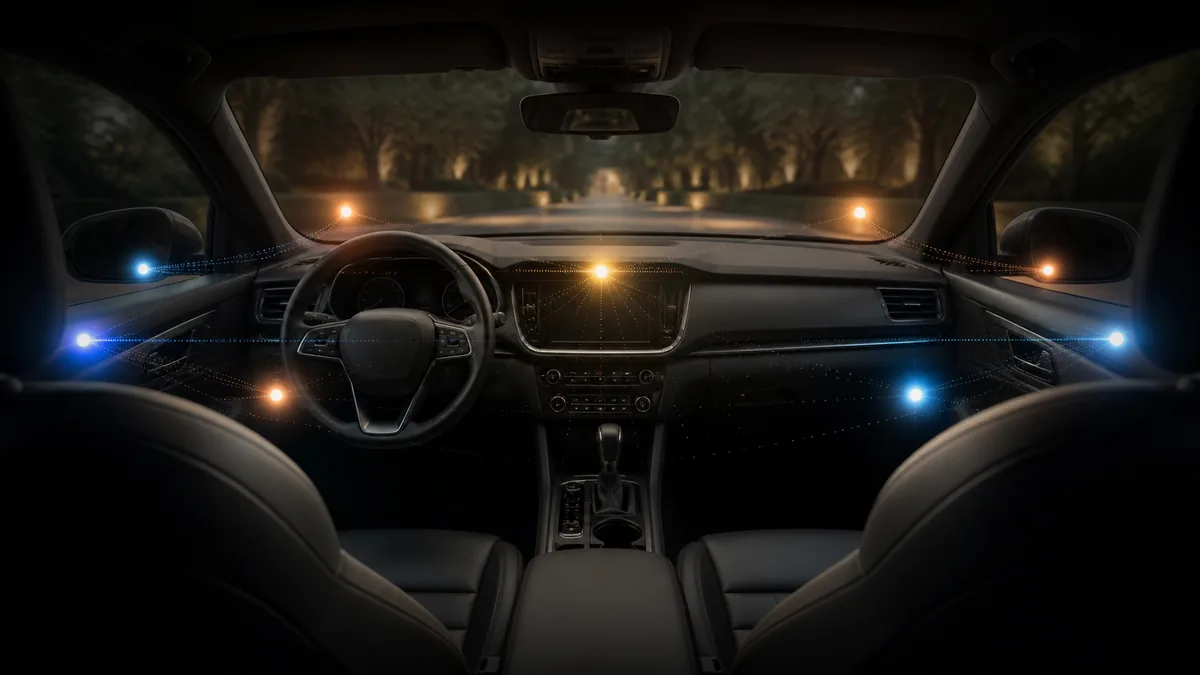
Soundstage describes the perceived space in which reproduced sounds appear. Imaging describes how distinctly and stably individual sounds are located within that space. They are related listening concepts, not synonyms.
Listening terms separated
| Term | Main question it answers | Example description |
|---|---|---|
| Soundstage | Where does the overall reproduced scene seem to exist? | Wide, narrow, high, low, deep, shallow, forward |
| Imaging | How precisely can individual sources be located? | A vocal has a stable center; instruments occupy distinct positions |
| Localization | Where does a particular sound seem to come from? | The sound pulls toward a door speaker or stays near the dashboard |
| Instrument separation | Can simultaneous parts be distinguished? | Two nearby instruments remain perceptually separate |
| Tonal balance | How is level distributed across frequency? | Bright, warm, bass-heavy, mid-forward |
A system can have a wide apparent stage but vague images, or precise center localization inside a narrow stage. Tonal balance may influence perception, but it is another attribute.
Why a car creates an asymmetric listening problem
The driver’s seat is closer to speakers on one side than the other. Direct-path distances, angles, reflections, and obstructions differ between channels. DENSO TEN’s technical discussion of sound-image localization identifies unequal arrival distances from left and right speakers as a central vehicle challenge.
The cabin also contains glass, trim, seats, footwells, and boundaries that reflect or absorb different parts of the spectrum. The perceived result is therefore a system-and-cabin interaction, not a property of one speaker in isolation.
The recording sets the available scene
Stereo playback can reproduce spatial cues that were captured or created in the recording and mix. If the program is mono, strongly panned, phase-altered, or deliberately diffuse, the apparent image will reflect that content.
Before diagnosing the car, compare with a familiar, well-produced reference track and understand mono versus stereo.
Why “the speakers disappear” is useful shorthand
Listeners often describe a strong front stage as if sound sources appear across the dashboard rather than coming directly from the door speakers. Crutchfield’s soundstage and imaging overview uses this front-of-listener framing to explain the goal.
It remains a perceptual description. The physical speakers have not moved, and a single subjective phrase is not a complete measurement method.
Controls that can affect the result
Speaker placement and aiming, channel level, polarity, acoustic phase, crossover behavior, equalization, time alignment, reflections, and seat position can all affect localization and stage perception. They interact; one control should not be presented as a universal fix.
A car-audio DSP can provide relevant processing functions, but owning a DSP does not guarantee correct spatial tuning.
Scope boundary
This page defines listening vocabulary. It does not prescribe speaker placement, delay values, polarity changes, or an EQ curve. Those choices require measurements, repeatable listening references, exact system knowledge, and a separately reviewed tuning workflow.
Last verified: August 22, 2026.
Sources
- DENSO TEN, Technical Review: sound image localization.
- Crutchfield, Stereo imaging and soundstage.