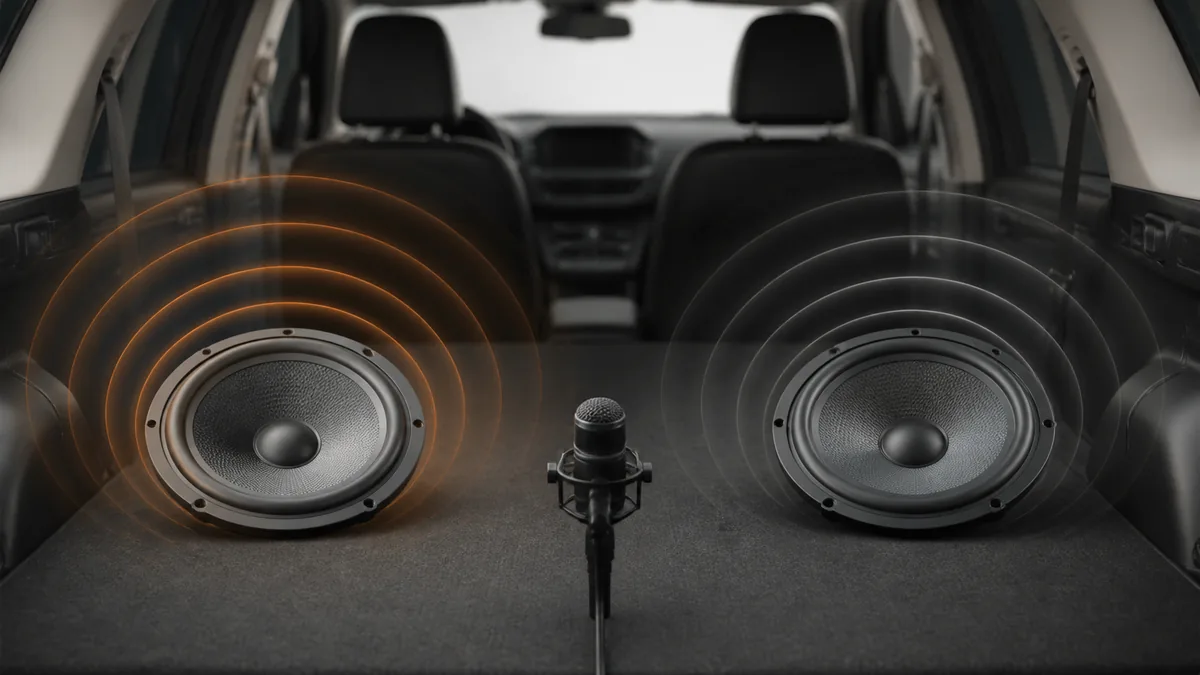
Speaker sensitivity describes acoustic output under a stated electrical input and measurement condition. It helps compare how much sound pressure different speakers produce from a defined stimulus, but the number is meaningful only with its test method.
A sensitivity rating is not a sound-quality score, a maximum loudness rating, or proof that one speaker will be louder in every vehicle.
Read the complete label
A specification might be written in a form such as dB SPL at 1 W/1 m or dB SPL at 2.83 V/1 m. Those labels do not always describe the same electrical input.
At a nominal 8 Ω resistive model, 2.83 V corresponds to approximately 1 W. At a nominal 4 Ω model, the same voltage corresponds to approximately 2 W. A voltage-referenced result can therefore appear higher than a one-watt result partly because the test delivers more modeled power.
Real loudspeakers have frequency-dependent impedance rather than one perfect resistance, so the applicable standard and manufacturer’s method still matter.
Conditions that change interpretation
| Specification detail | Why it matters | Comparison mistake to avoid |
|---|---|---|
| Input reference | One watt and 2.83 volts are not universally equivalent | Comparing numbers without converting or checking nominal impedance |
| Measurement distance | Sound pressure changes with distance and environment | Treating a 0.5 m result as a 1 m result |
| Frequency or bandwidth | Output varies across frequency | Comparing a peak at one frequency with a broadband average |
| Acoustic environment | Anechoic, half-space, baffle, box, door, and cabin conditions differ | Assuming a laboratory number predicts installed response |
| Product scope | A single driver, coaxial assembly, or system may be rated differently | Comparing unlike devices as if the same parts were measured |
| Tolerance and method | Smoothing, averaging, microphone position, and limits affect the result | Treating every published integer as equally precise |
The AES loudspeaker measurement standard listing demonstrates why loudspeaker performance requires defined measurement methods rather than an unlabeled decibel number.
Sensitivity versus efficiency
The words are often used interchangeably in shopping discussions, but they are not identical.
- Sensitivity reports acoustic output for a stated input and condition.
- Efficiency is a ratio of acoustic power output to electrical power input.
A sensitivity specification is usually the number users encounter on car-speaker product pages. Calling it “efficiency” can be conversationally understandable, but technical writing should preserve the distinction.
What a higher number can imply
When two ratings are produced by genuinely comparable methods, the speaker with the higher sensitivity rating produces more measured sound pressure from that stated input in the test condition.
That can matter when amplifier output is limited, but it does not establish:
- the maximum clean output before compression or damage;
- the frequency response shape;
- distortion at the desired listening level;
- bass extension;
- dispersion or imaging;
- thermal and mechanical limits;
- installed output in a particular door or enclosure.
A sensitive speaker can still have limited low-frequency extension or output capability. A less sensitive speaker can still be the appropriate choice for a different bandwidth, enclosure, or design target.
Why installed output differs
The vehicle changes the result through mounting, leaks, baffles, grilles, door volume, reflections, seat position, crossover behavior, and interaction with other drivers. Amplifier voltage, clipping, equalization, and source limits add further variables.
The Crutchfield car-speaker glossary defines sensitivity alongside other speaker terms. It should be read as one specification among many, not a ranking of total performance.
Sensitivity does not determine required amplifier power
It is tempting to turn sensitivity into a single amplifier-size rule. That skips the listening distance, target level, bandwidth, cabin contribution, number of speakers, headroom, impedance behavior, and speaker limits.
A valid system calculation needs those assumptions and still must be checked against the manufacturer’s continuous rating and the amplifier’s supported load and operating conditions. This page does not provide a power-matching procedure.
A comparison checklist
Before using two sensitivity ratings:
- Confirm the same input reference: watts or volts.
- Confirm the distance.
- Check nominal impedance when interpreting a voltage reference.
- Identify the frequency or averaging bandwidth.
- Check whether the acoustic test environment is described.
- Compare the same product scope and intended bandwidth.
- Treat missing methodology as uncertainty, not permission to assume equivalence.
Review decibels in car audio for logarithmic comparisons and RMS versus peak power ratings before combining sensitivity and power claims.
Last verified: August 22, 2026.
Sources
- Audio Engineering Society, AES2 loudspeaker measurement standard listing.
- Crutchfield, Car speakers glossary.