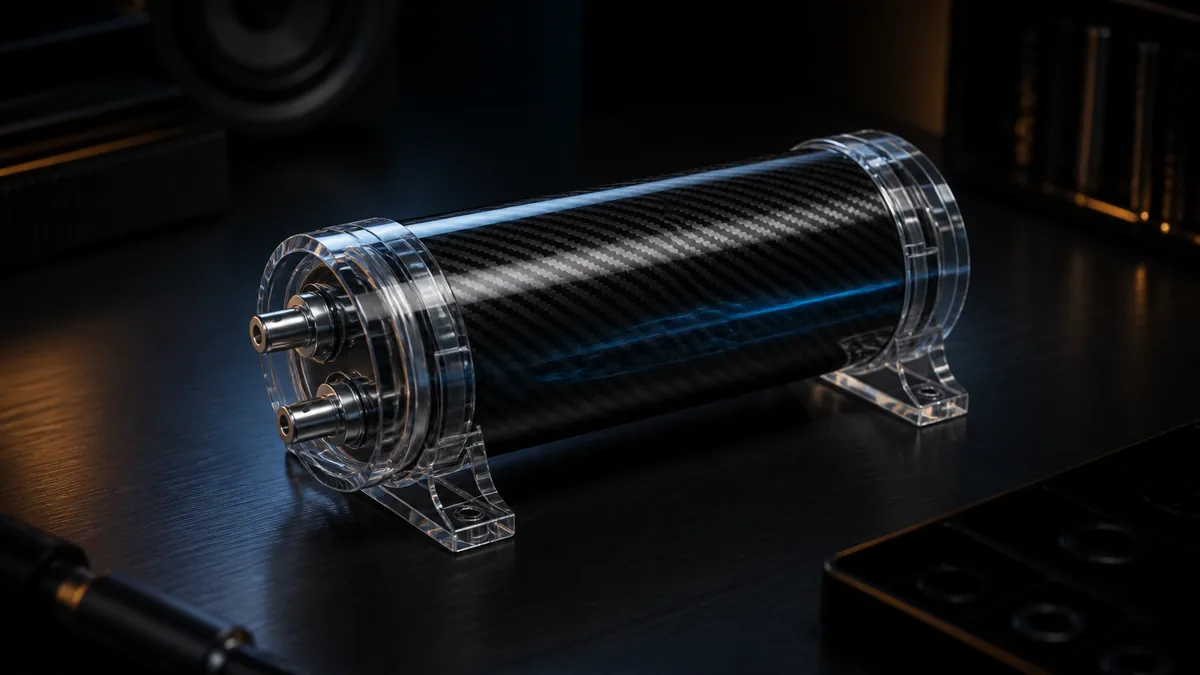
A car-audio capacitor stores electrical energy and can release it over a brief interval. It does not generate energy, recharge itself, increase an alternator’s sustained output, restore a degraded battery, or eliminate resistance in an undersized/poorly terminated conductor.
That makes “Do capacitors work?” incomplete. The answer depends on the measured problem and its time scale.
Match the component to the symptom
| Observed problem | Capacitor relevance | What must be checked first |
|---|---|---|
| Very brief voltage excursion at the amplifier during a transient | A properly selected/installed capacitor may buffer part of it | Measurement bandwidth/location, source path, capacitor ESR/capacitance, manual |
| Sustained low voltage under continuous demand | Cannot create missing sustained energy | Alternator output, battery state, conductor/termination drop, total load |
| Engine-off listening drains battery | Capacitor is not a substitute for required energy storage | Battery capacity/condition and use duration |
| Hot or discolored connection | Does not repair resistance or termination damage | Isolate and repair the actual fault |
| Headlights vary with music | Symptom alone does not size or justify a capacitor | Voltage at relevant points, charging behavior, conductor path, vehicle controls |
| Amplifier clips or enters protection | Capacitor is not a universal clipping/protection cure | Signal, load, supply at terminals, heat, exact fault code |
JBL’s power-capacitor paper describes rapid storage/delivery for short peaks and explicitly says a capacitor cannot correct a battery or alternator problem. JL Audio’s School of Sound similarly places capacitors in the context of very brief demand while distinguishing batteries and alternators.
Diagnose before buying
Record the amplifier’s exact load/mode and output demand, vehicle operating state, charging-system control behavior, battery condition, conductor material/gauge/run, fuse/distribution path, and voltage at both source and amplifier during the repeatable event. A slow meter may miss a brief transient; one measurement at the battery does not reveal drop along the path.
Read battery vs alternator for their different roles and voltage drop for the source-to-load measurement model. Do not choose a capacitor merely from amplifier “max watts.”
Installation adds stored-energy risk
A charged capacitor can remain hazardous after the vehicle is off. Charging, discharging, polarity, fuse protection, mounting, conductor sizing, terminal covers, and service isolation are product- and installation-specific. Reverse polarity or a short can cause severe current, heat, venting, or component damage.
Use the exact capacitor and vehicle instructions. Do not improvise a charging resistor value, bridge terminals with a tool, assume a display means zero stored energy, or mount a heavy cylinder unsecured. A qualified automotive electrical installer should handle the work when safe isolation and verification are not understood.
When it is a defensible system component
A capacitor is defensible when measurements identify a brief local demand issue, the source and conductors are already healthy, the selected product’s electrical characteristics suit the application, and installation complies with every manual. Even then, evaluate the result with before/after measurements at the same points and conditions.
If voltage remains low over a sustained interval, solve sustained generation, storage, resistance, or load—not the marketing category.
Last verified: August 23, 2026.
Sources
- JBL, Using Power Capacitors.
- JL Audio, School of Sound.