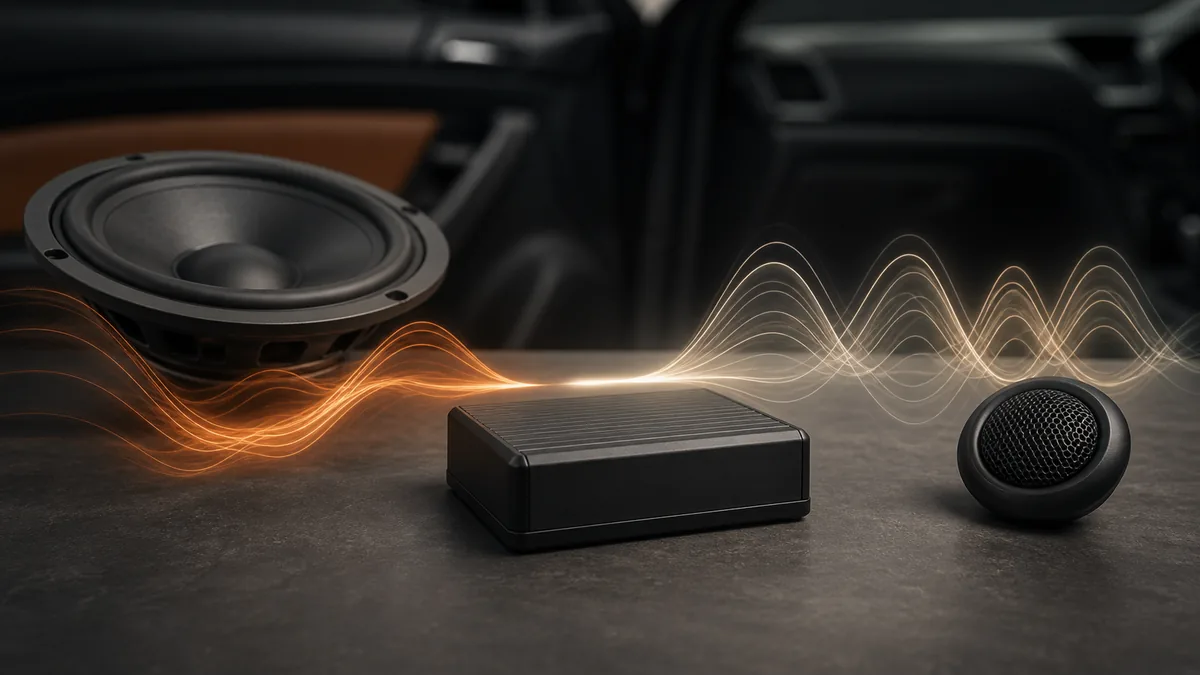
A car-audio crossover uses frequency-selective filters to divide work among outputs or loudspeaker drivers. It attenuates parts of the signal outside an intended range; it does not create extra frequencies or guarantee that the resulting acoustic response will be correct.
The word can describe a function, a group of settings, or a physical component. Identifying which meaning is intended is more useful than looking for one box labeled “crossover.”
The basic job
A tweeter, midrange, woofer, and subwoofer are designed for different roles. A crossover helps route or limit frequency regions so each output handles an intended part of the spectrum.
Common filter descriptions include:
- a high-pass filter (HPF), which attenuates frequencies below its transition region;
- a low-pass filter (LPF), which attenuates frequencies above its transition region;
- a band-pass result, formed when both lower and upper boundaries are applied;
- a multiway crossover, which coordinates two or more filtered paths.
The named frequency is not a brick wall. Real filters transition over a range, and their slope and alignment affect level and phase around that transition.
Where crossovers can operate
| Implementation | Position in the signal path | What it controls | What the label does not establish |
|---|---|---|---|
| Passive crossover | After a power amplifier, before individual drivers | How the amplified signal is divided by a component network | Correct values for a different driver set |
| Active analog crossover | Before the relevant power-amplifier channels | Frequency-selective line-level paths | Digital processing or automatic tuning |
| DSP crossover | Inside a digital signal processor, receiver, or DSP amplifier | Configurable filters assigned to outputs | A safe setting without driver and system information |
| Built-in amplifier filter | Inside an amplifier’s input/processing section | The bandwidth sent through selected amplifier channels | That every channel has the same controls or range |
AudioControl’s overview of active and passive crossovers illustrates the main location difference: passive networks work on amplified output, while active processing divides the signal before final amplification.
Active does not mean automatic
An active crossover needs powered circuitry or processing, but it does not necessarily measure the vehicle or choose settings. A DSP can expose filter type, frequency, and slope while still depending on the user to configure those controls correctly.
The product-specific AudioControl DM-series manual shows crossover controls assigned to processor outputs alongside routing, delay, level, and equalization. That documents one implementation, not a universal menu or recommended frequency.
A passive crossover contains components such as capacitors and inductors. Component speaker sets often include a network designed for the supplied drivers. Substituting another network merely because its terminals fit does not prove that its electrical or acoustic behavior is suitable.
Crossover frequency is not a complete setting
Two controls showing the same frequency can behave differently because a full filter description can also depend on:
- filter type or alignment;
- slope or order;
- electrical response of the filter;
- driver impedance and behavior;
- polarity and acoustic phase;
- placement, path length, and vehicle acoustics;
- interaction with another filter already in the signal path.
This is why “set every crossover to 80 Hz” is not a universal engineering rule. A valid setting depends on the actual drivers, enclosure, amplifier/processor controls, system goals, and measurements.
Crossover versus equalizer
Both change level by frequency, but their primary jobs differ. A crossover defines intended operating regions for outputs or drivers. An equalizer shapes level within the reproduced spectrum. A processor may display both on the same screen, and both can influence the final response, but one does not replace the other.
One filter is not always the whole crossover
A low-pass filter on a subwoofer channel is one part of frequency division. The main speakers may also need complementary high-pass behavior. Passive components inside a speaker assembly can add further filtering. Factory processing may already be changing bandwidth before an aftermarket processor receives the signal.
The Crutchfield speaker glossary distinguishes crossover and driver roles, but the applicable operating range still comes from the exact products and system design.
Questions to ask before settings
Before choosing a number, identify:
- Which input and output channels are involved?
- Is the filter before or after power amplification?
- Is another filter already active upstream or downstream?
- What operating range does the driver manufacturer document?
- What filter types and slopes does the actual device provide?
- How will the electrical settings be verified acoustically?
Those questions belong to a later measurement-led setup procedure. This page owns the crossover concept, not installation diagrams or universal settings.
Continue with coaxial versus component speakers to see where passive networks commonly appear, or review what a DSP does for one place active filtering can live.
Last verified: August 22, 2026.
Sources
- AudioControl, What Is an Active vs Passive Crossover in a Car Audio System?.
- AudioControl, DM-608 and DM-810 Installation Manual.
- Crutchfield, Car speakers glossary.