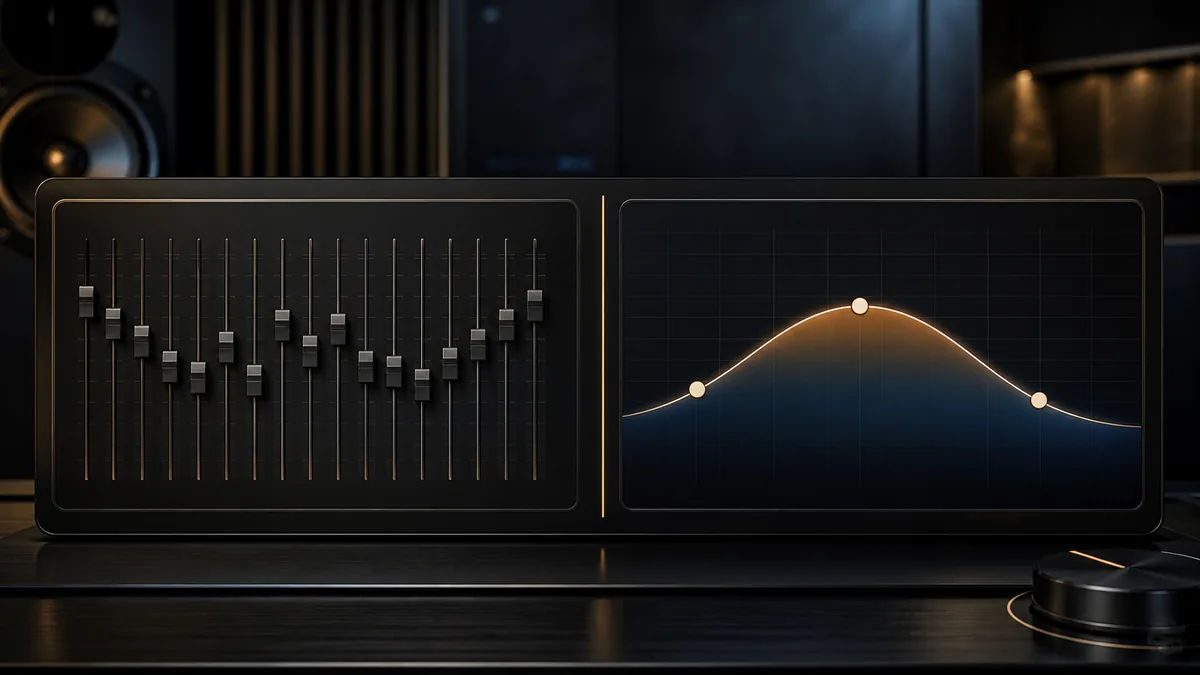
A graphic equalizer gives you a fixed set of frequency bands whose levels can be raised or lowered. A parametric equalizer lets you choose more of each filter’s parameters—typically frequency, gain, and bandwidth or Q.
Control differences
| Parameter | Graphic EQ | Parametric EQ |
|---|---|---|
| Center frequency | Fixed band locations | Selectable within the allowed range |
| Gain/cut | Adjustable per band | Adjustable per band |
| Bandwidth / Q | Usually fixed by the design | Adjustable on a fully parametric band |
| Interface | Row of sliders or fixed bands | Frequency, gain, and Q controls for each filter |
| Typical strength | Fast, visible broad shaping | Precise placement and width control |
The miniDSP comparison defines a parametric filter through frequency, gain, and Q. Rane’s equalizer overview covers operator-adjustable equalizer families and points to the distinct constant-Q graphic-EQ design literature, illustrating why the label alone does not fully describe how neighboring bands interact.
Why it is called graphic EQ
The slider positions form a rough visual picture of the chosen boosts and cuts. Each slider owns a predetermined part of the spectrum, so the interface is quick to scan.
However, the slider line is not a literal high-resolution graph of the acoustic result. Adjacent filters overlap, the speaker and cabin add their own response, and the displayed control position does not show every phase or magnitude effect.
What “parametric” adds
A fully parametric band normally provides three parameters:
- Frequency: where the filter is centered.
- Gain: how much level is added or removed.
- Q or bandwidth: how narrow or broad the affected region is.
Some products use semi-parametric or paragraphic controls with only part of that flexibility. The exact software or manual defines what each control actually changes.
More control is not automatic improvement
Parametric EQ can target a narrower measured feature, but it can also make it easier to chase measurement noise, seat-specific variation, or a cancellation that boost cannot repair. Graphic EQ can be easier for broad preference changes, but its fixed bands may not align with the feature being addressed.
Neither format guarantees better sound. The measurement method, target, filter behavior, headroom, speaker limits, and listening evaluation still control the result.
EQ and crossovers solve different jobs
An equalizer changes level within frequency regions. A crossover assigns or limits operating bands for driver paths. A DSP may contain both, but combining them in one device does not make their functions interchangeable.
Read high-pass versus low-pass filters and what a DSP does for those neighboring concepts.
Scope boundary
This page compares interfaces and filter control. It does not provide “best EQ settings,” a target curve, microphone procedure, or correction workflow. Those depend on measurements, equipment, seat, goals, and available headroom.
Last verified: August 22, 2026.
Sources
- miniDSP, PEQ vs Graphic EQ.
- Rane Commercial, Operator Adjustable Equalizers: An Overview.