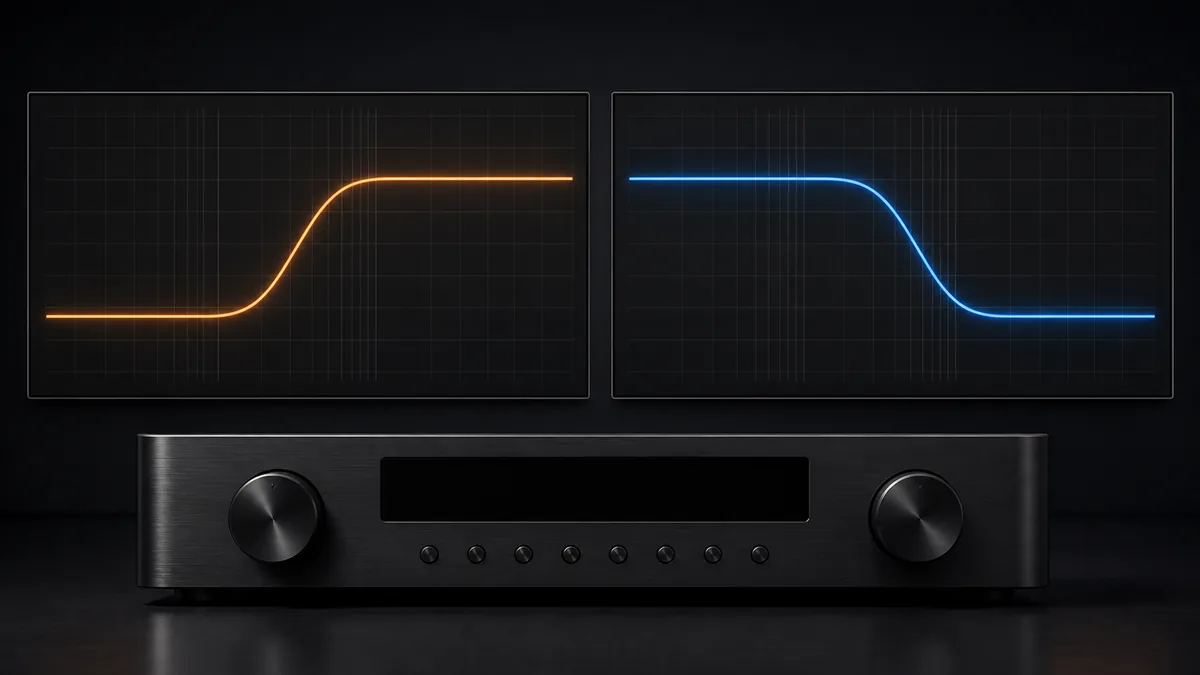
A high-pass filter passes the higher-frequency side of a signal while attenuating frequencies below its transition region. A low-pass filter does the opposite: it passes the lower-frequency side and attenuates frequencies above it.
HPF and LPF side by side
| Filter | Frequencies primarily passed | Frequencies progressively attenuated | Also called |
|---|---|---|---|
| High-pass filter (HPF) | Above the transition/cutoff region | Below the transition/cutoff region | Low-cut filter |
| Low-pass filter (LPF) | Below the transition/cutoff region | Above the transition/cutoff region | High-cut filter |
| Band-pass filter | Between lower and upper boundaries | Below the lower and above the upper boundary | Combined high-pass and low-pass behavior |
Texas Instruments’ automotive active-filter brief shows high-pass and low-pass stages used to divide automotive audio frequency ranges. JBL’s crossover guidance uses the familiar HP and LP labels on amplifier controls.
“Pass” names the side that remains
The easiest way to remember the terms is to follow the word pass:
- high-pass keeps the higher-frequency side;
- low-pass keeps the lower-frequency side.
“Low cut” and “high pass” describe the same direction from opposite perspectives. The first names what is reduced; the second names what remains.
The cutoff is not an on/off wall
Real filters transition over a range. Frequencies on the attenuated side become progressively lower in level according to the filter shape and slope. At the stated cutoff frequency, the signal is not generally “all gone.”
The exact response depends on filter family, order/slope, alignment, adjacent filters, and implementation. This is why knowing only a frequency number does not fully describe a crossover.
A crossover may use both
In a two-way active crossover, one branch can apply a low-pass filter to the lower-frequency driver while another applies a high-pass filter to the higher-frequency driver. The two electrical responses and the drivers’ acoustic behavior combine in the cabin.
A lone HPF or LPF can still be useful, but it is not automatically a complete complementary crossover. Read what a car-audio crossover does for the larger routing concept.
Why there is no universal “best” cutoff here
An appropriate filter depends on:
- the exact speaker and enclosure or mounting behavior;
- manufacturer limits;
- target output;
- acoustic response at the listening position;
- other active or passive filters already in the path;
- slope, phase, polarity, and alignment choices.
Copying a popular number without those conditions can leave overlap, create a gap, or send unsuitable content to a driver.
Scope boundary
This page owns HPF/LPF terminology. It does not prescribe cutoff frequencies, slopes, subsonic-filter settings, or a tuning sequence. Those are separate measurement and configuration intents requiring a stronger review gate.
Last verified: August 22, 2026.
Sources
- Texas Instruments, Active Filtering in Automotive Audio Applications.
- JBL / Harman International, Setting the Crossover and Input Sensitivity.