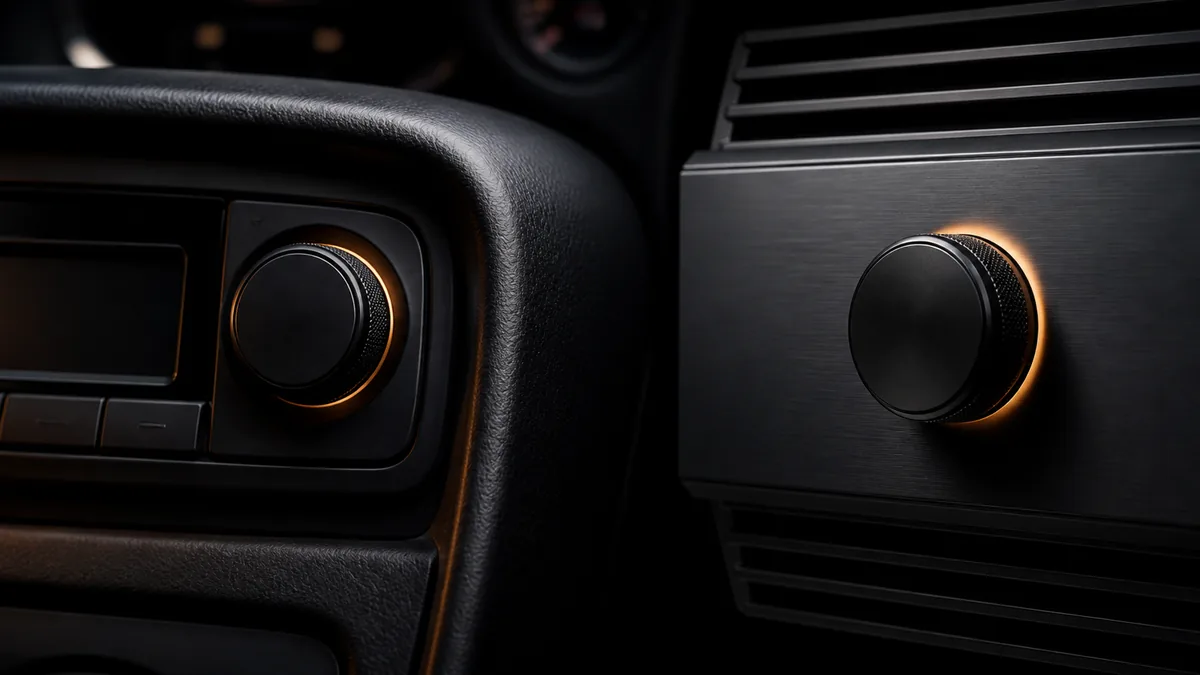
An amplifier’s gain control and a stereo’s volume control can both change how loud the system seems, but they do different jobs. Gain establishes how the amplifier responds to its input signal; volume is the normal listening-level control.
Control roles compared
| Control | Primary job | Normal use | Important limitation |
|---|---|---|---|
| Source volume | Changes listening signal level | Adjusted while listening | The source can have a maximum clean-output boundary |
| Amplifier gain/input sensitivity | Matches the amplifier input stage to the available source signal | Calibrated during setup | It does not create extra rated amplifier capability |
| Remote level control | Varies a defined channel, range, or function | Product-dependent convenience adjustment | It may attenuate level, vary bass boost, or behave another way |
| Bass boost | Applies frequency-selective equalization | Product-dependent tuning control | It is neither master volume nor input-sensitivity calibration |
Focal’s gain guidance explicitly distinguishes gain from volume and describes it as matching radio output voltage to amplifier input. JBL’s input-sensitivity guidance frames the goal as achieving the amplifier’s clean output rather than treating the control as extra listening volume.
Why turning gain up seems louder
With the same source-volume position, increasing amplifier sensitivity can produce more output from the available input signal. That immediate loudness change makes the knob feel like a second volume control.
But the amplifier still has an output limit. If the signal chain asks for more output than a stage can reproduce cleanly, that stage can clip. Raising gain can simply reach that boundary at a lower source-volume position.
Read audio clipping for the waveform concept. The setting procedure itself is a separate, measurement-led topic because source, processor, amplifier, load, test signal, and manufacturer method all matter.
The knob direction can be confusing
Some amplifier panels mark their input-sensitivity range in volts. On such controls, the visual scale may run opposite the user’s intuition: the end labeled with a lower input-voltage value corresponds to greater sensitivity. Other products use minimum/maximum markings or software values.
The panel label and applicable manual—not knob position copied from another system—define what the control means.
Remote bass knobs are not universal
“Bass knob” is informal wording. Depending on the product, a remote can:
- attenuate a subwoofer channel from a calibrated maximum;
- control a bass-boost circuit;
- change processor output level;
- perform another documented function.
Its behavior cannot be inferred from the connector shape or the word “remote.” Check the exact model manual before deciding where the control belongs in gain structure.
Gain does not repair an upstream problem
More sensitivity cannot restore information removed by factory processing, fix a clipped source, correct a wrong input mode, or add amplifier headroom. The complete car-audio signal path must be considered stage by stage.
Scope boundary
This page defines controls; it does not provide a gain-setting procedure or a safe knob position. A future guide will compare manufacturer-approved measurement methods and will remain separately risk-gated.
Last verified: August 22, 2026.
Sources
- Focal, How do I set the gain on my amplifier?.
- JBL / Harman International, Setting the Crossover and Input Sensitivity.