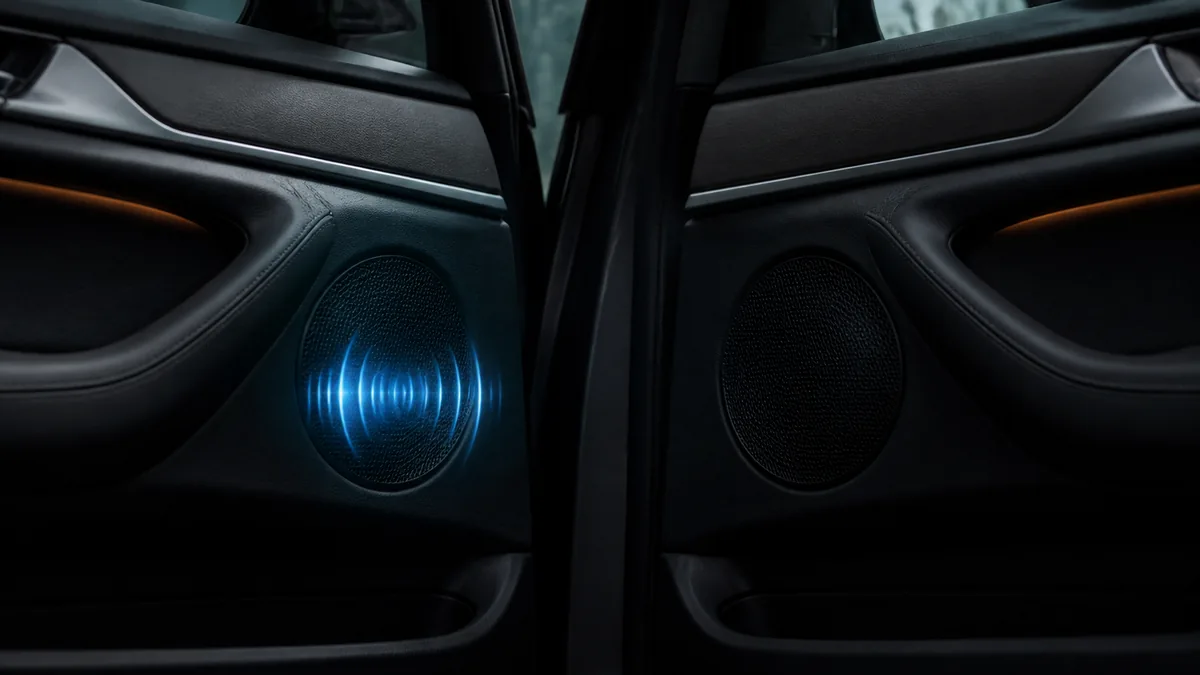
One silent speaker is not automatically a blown speaker. The missing channel may begin at the source, balance/fader, DSP routing, amplifier input/output, a door connector, a flexing harness section, a passive crossover, or the driver itself.
First determine whether the symptom follows one physical speaker, one channel, or one whole side.
Build the symptom boundary
| Test condition | Useful observation | Likely boundary—not a verdict |
|---|---|---|
| All sources lose the same speaker | Shared downstream path for that channel | Amplifier output, harness, connection, crossover, or speaker |
| Only one source loses it | Source or source-specific routing | Not necessarily the speaker |
| Front and rear on one side are silent | Balance/routing, shared interface, or multi-channel path | Unlikely to be two independent driver failures, but still unproven |
| Sound returns with door position or bumps | Intermittent connection or flexing harness is plausible | Do not deliberately flex powered wiring |
| Tweeter works but door woofer does not | Band-specific output, passive network, wiring, or driver | The whole channel is not silent |
| Distortion preceded silence | Driver, connection, clipping, or amplifier damage is possible | Which part failed |
Confirm balance and fader are centered, channel mute/solo controls are clear, and DSP output routing matches the installed system. Test another known source at a low level.
Trace one channel end to end
Write the path as named devices: receiver output → interface/DSP channel → amplifier input → amplifier output → vehicle harness/door connector → passive crossover → speaker. Factory systems may route multiple drivers independently, so a door location is not always one channel.
KICKER’s KXMA manual treats connections, signal, balance/fader, mute, and output/load conditions as separate troubleshooting checks. That separation is more defensible than replacing the easiest part first.
Swap only at a documented, low-risk boundary
A controlled channel swap can show whether a symptom follows an upstream signal or remains on one downstream path, but it is safe only where the applicable manuals permit the connection and with power removed as specified. Label the original state and change one pair at a time.
Do not move a speaker onto an unknown amplifier channel, bridge terminal, factory-network lead, or incompatible load. Do not let disconnected conductors touch. If you cannot identify the terminals and power-down procedure, stop.
An ordinary resistance measurement can help identify an open circuit only within a documented isolated procedure. It does not reproduce operating impedance, confirm correct polarity through the vehicle, or prove a speaker behaves under motion and heat.
Keep noise and silence separate
AudioControl’s noise-suppression technical paper uses isolation by subsystem and connection path. The same reasoning discipline helps here: locate where the symptom enters before treating every conductor as the cause.
If the channel crackles or pops rather than remaining silent, preserve when it occurs and use the crackling/popping guide. If every channel is silent although the stereo is lit, use the system no-sound guide.
Stop for odor, scraping, visible cone/surround damage, wet connectors, pinched insulation, an airbag-area harness, or repeated amplifier protection. The repair boundary depends on the exact vehicle and equipment documentation.
Last verified: August 23, 2026.
Sources
- KICKER, 2021 KXMA 5-Channel Amplifier Owner’s Manual.
- AudioControl, Tech Paper 103: Car Audio Noise Suppression Guide.