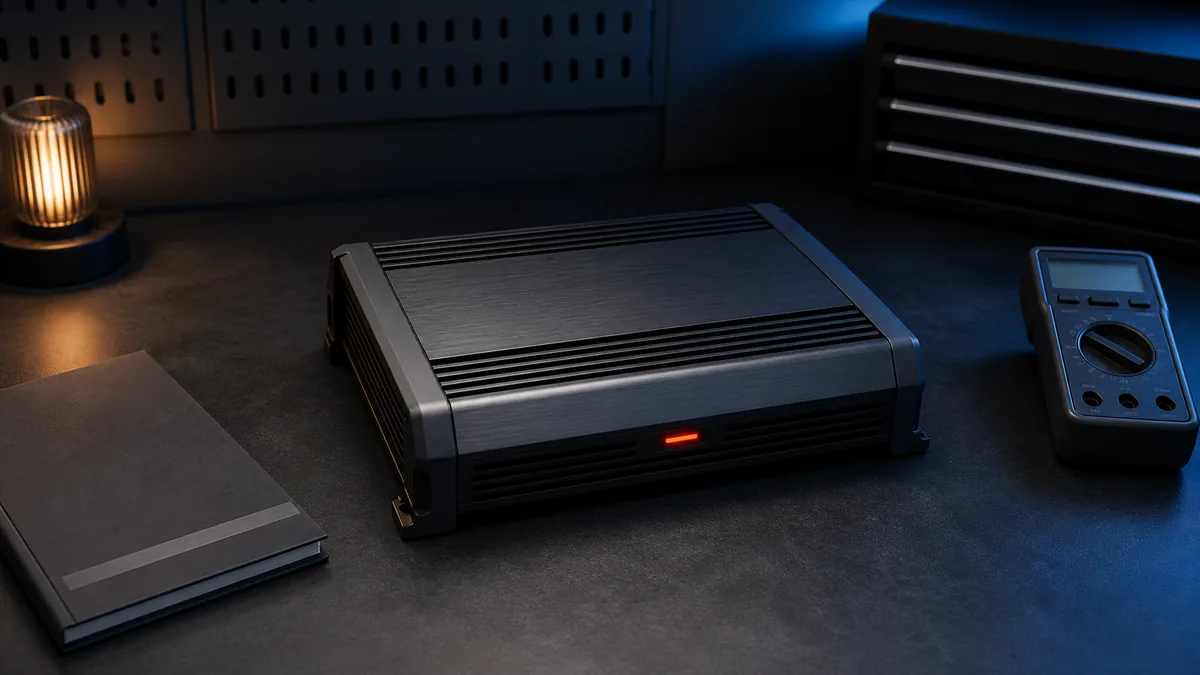
Amplifier protect mode means the amplifier’s monitoring system has responded to a condition defined by that product. It is a symptom category, not a diagnosis and not permission to bypass the circuit.
The safest first action is to reduce level, stop repeated resets, record the indicator behavior, and read the troubleshooting table for the exact amplifier model and revision.
Interpret the pattern before testing
| Observed pattern | Evidence-led branch | Do not conclude yet |
|---|---|---|
| Protect is present immediately at startup | Check the manual’s code plus installation state, supply, outputs, and internal-fault escalation | “The amplifier is dead” |
| Protect appears only with louder music or bass transients | Capture supply behavior at the amplifier and investigate load/output faults under the manual’s procedure | “The battery is definitely bad” |
| Protect appears after operating for a while | Check temperature, airflow, mounting, load, and operating demand | “Heat alone is the cause” |
| Protect occurs only while the engine runs | Compare the exact code with the product’s allowed supply behavior | “The alternator is too powerful” |
| A numbered or repeating flash code appears | Decode that exact sequence in the applicable manual | A generic meaning found for another brand |
KICKER’s KXMA manual associates its own protection indications with conditions including low battery voltage, thermal protection, supply outside the documented range, shorted speaker wiring, damaged speakers, or operation below the recommended impedance. These meanings are evidence for that series only.
AudioControl’s Epicenter amplifier manual uses distinct flash codes for short, repeated short, under-voltage, over-voltage, DC offset, and thermal conditions. That different implementation proves why the light color alone is insufficient.
Step 1: preserve evidence
Record the exact model, serial/revision if available, indicator color and sequence, engine state, source, level, elapsed operating time, affected channels, and recent changes. Note whether the amplifier automatically recovers or requires a power cycle.
Do not repeatedly reproduce a fault at high output. Repetition can heat a poor termination, stress a speaker, or erase the distinction between the initial fault and a later thermal event.
Step 2: apply the manual’s stop condition
If there is smoke, odor, melted insulation, a hot terminal, liquid exposure, battery damage, a loose high-current conductor, or repeated fuse operation, stop. Isolate the system only through the vehicle- and product-appropriate procedure. Use a qualified automotive electrician or installer when that procedure is not known.
Never bypass the protection circuit or replace a fuse with a larger value to “see if it holds.” A fuse that opens is evidence requiring diagnosis, not an output limitation to defeat.
Step 3: separate the four common boundaries
Supply boundary
The relevant observation is voltage at the amplifier terminals under the state where the fault occurs, measured with suitable equipment and a safe method. Battery-post voltage taken at rest does not prove what the amplifier receives during a transient, nor does one meter necessarily capture a brief event.
Compare the result only with the exact manual. Do not transplant KICKER’s model-specific limits into another amplifier.
Output and load boundary
Shorted conductors, damaged speakers, incorrect topology, or a nominal load below the documented channel/mode limit can trigger protection. Use the exact system record and verified nominal-load calculation; do not treat an ordinary DC-resistance reading as the complete operating impedance curve.
The subwoofer wiring calculator validates a limited set of balanced nominal configurations. It does not inspect installed wiring or approve an amplifier.
Thermal boundary
An amplifier that is hot and in protection may have reached a thermal threshold. Airflow, mounting, ambient temperature, load, sustained output, and internal condition can contribute. Cooling and automatic recovery confirm a temperature relationship, not the root cause.
Signal and control boundary
Input overdrive, unintended bass boost, factory processing, or an upstream fault can make a level-dependent problem appear to be purely electrical. Protection is distinct from clipping, though the same operating change may expose both. Read clipping for the waveform concept.
Step 4: change one variable under a documented procedure
A defensible test has a hypothesis, a safe method from the manual, one controlled change, and an observable result. Record measurements before and after. If the manual instructs output disconnection, speaker substitution, or live electrical measurement, perform it only with the required power-down sequence, tools, and competence.
Stop remote diagnosis when the code persists with documented external checks complete, when an internal fault code is reported, or when the installation cannot be accessed safely. Manufacturer support or a qualified repair facility is the next boundary—not opening the amplifier.
What this guide deliberately does not provide
It provides no universal voltage threshold, resistance verdict, ground location, wire size, fuse size, or terminal-disconnection sequence. Those depend on the exact amplifier, vehicle, conductor run, protection design, and installation. The visible technical safety notice below is part of this high-risk page; it does not replace competent work or the manufacturer’s instructions.
Last verified: August 23, 2026.
Sources
- KICKER, 2021 KXMA 5-Channel Amplifier Owner’s Manual.
- AudioControl, Epicenter 600/1200 Amplifier User Manual.