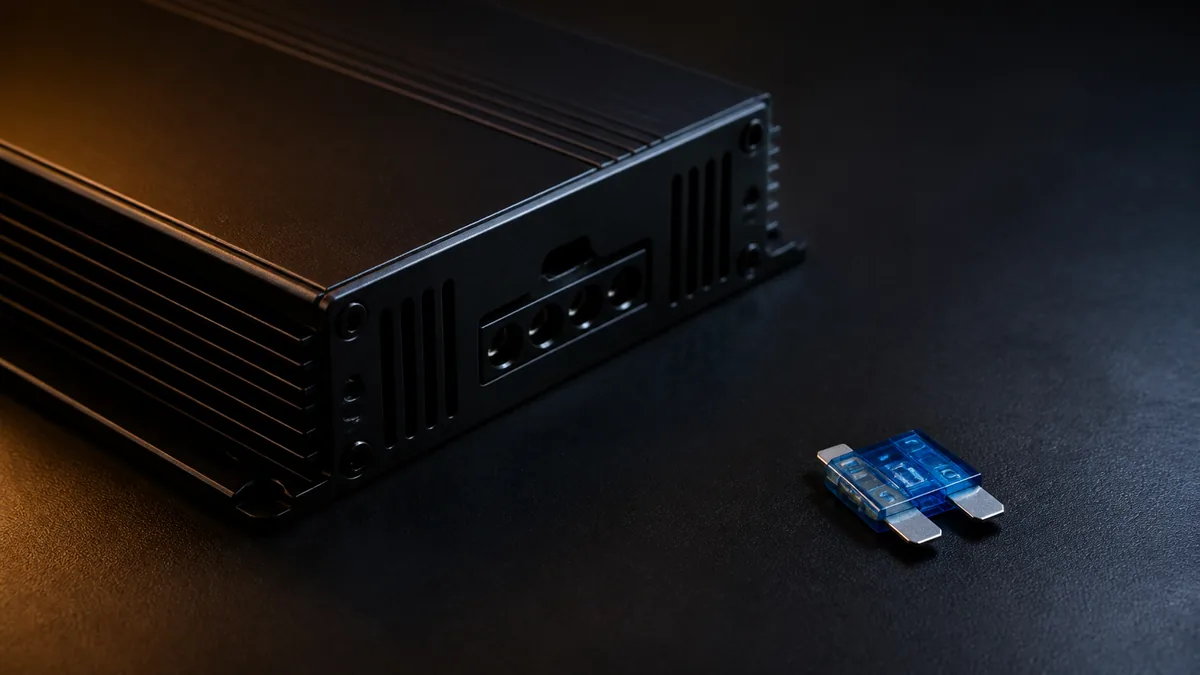
A fuse that opens repeatedly is a stop signal. It is not a consumable output control and not a request for a larger fuse. Replacing it again before locating the fault can increase heating and fire risk.
Do not install another fuse until you can identify which fuse opened, its documented value/type, and when it opened.
Identify the protected segment
| Fuse that opened | Circuit it may protect | Evidence still needed |
|---|---|---|
| Fuse near the battery/source | Main power conductor and downstream distribution within its designed scope | Exact placement, conductor path, distribution, ratings |
| Distribution-block branch fuse | One downstream branch/conductor | Branch destination and documented protection design |
| Fuse on/in the amplifier | Product’s internal/input supply path as designed | Exact model manual and correct replacement specification |
| Vehicle fuse-panel fuse | Vehicle circuit identified by factory documentation | Never assume it is only the stereo |
The fuse-placement guide explains why a source-end fuse and an amplifier-mounted fuse do different jobs. Fuse appearance alone does not prove the fault location.
Timing narrows the boundary
| When it opens | Investigate under documented isolation | Do not infer automatically |
|---|---|---|
| As the fuse is inserted | Hard short, reversed connection, damaged product, or unintended energized path | Amplifier is the only possible fault |
| At system turn-on | Startup/control event, product fault, conductor/terminal issue, or connected load | The fuse is “too small” |
| Only at higher output | Overcurrent, supply/conductor problem, load/output fault, heat, or incorrect protection design | Music power justifies upsizing |
| After bumps or service work | Intermittent conductor/termination damage is plausible | Safe to reproduce while driving |
| After water exposure | Contamination or corrosion may create an unsafe path | Drying alone proves repair |
Record engine state, elapsed time, output level, amplifier indicators, smell/heat, weather or water exposure, and recent installation changes.
Compare only with the exact manuals
KICKER’s KX-series manual and Rockford Fosgate’s Punch amplifier manual publish product-family-specific fuse, wiring, load, and installation requirements. Those numbers are not universal values for another amplifier or conductor run.
Confirm the exact model/revision, the installed fuse class and rating, every distribution stage, conductor material/gauge/run, termination, amplifier channel mode, and final nominal speaker load. An ordinary resistance reading across an installed system is not enough to certify it.
Safe escalation boundary
With all energy sources isolated according to vehicle and product procedures, a competent person can inspect for crushed insulation, exposed copper, loose strands, conductive debris, incorrect polarity, water, heat damage, and terminals contacting chassis. High-current batteries can deliver hazardous fault energy even when the audio system appears off.
Do not bypass the fuse, wrap it, bridge the holder, install a larger value, or repeatedly “test” replacements. Do not disconnect a battery without knowing vehicle retention, airbag, security, and manufacturer procedures.
If no visible external defect explains the event, or the specified fuse opens with documented external isolation complete, contact the amplifier manufacturer or a qualified automotive electrical technician. Opening the amplifier is outside this guide.
Last verified: August 23, 2026.
Sources
- KICKER, KX-Series Mono Amplifier Owner’s Manual.
- Rockford Fosgate, Punch Full Range Amplifier Installation and Operation Manual.