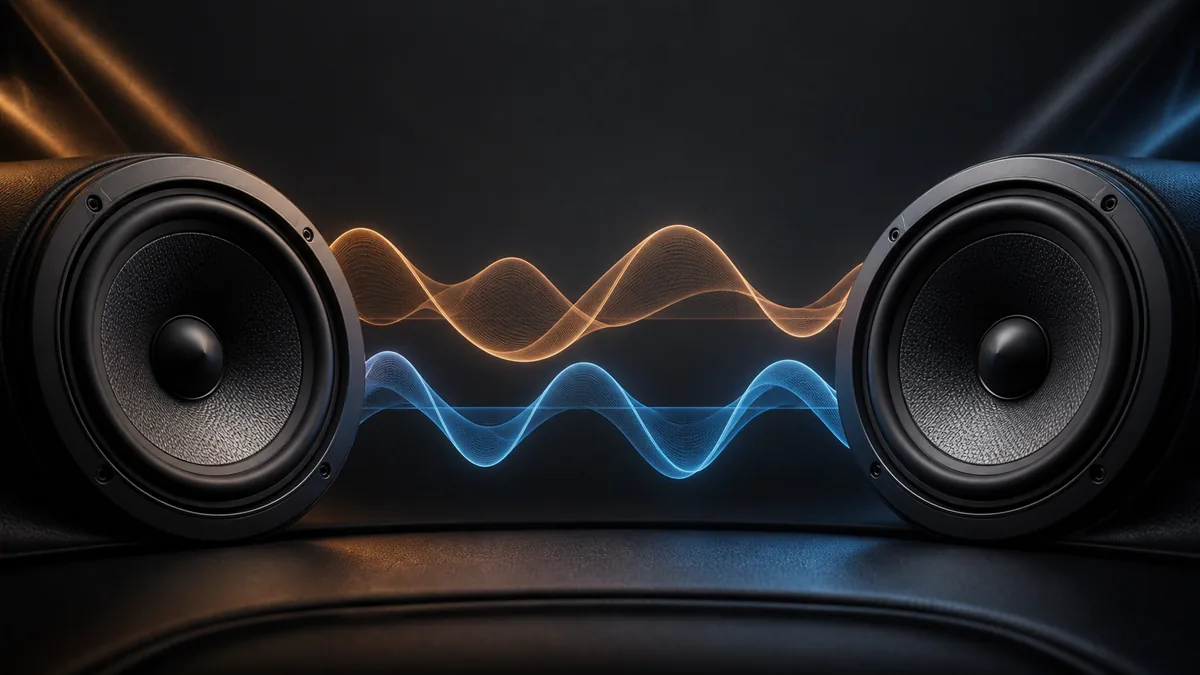
Polarity describes which way a signal or connection is oriented. Phase describes timing position within a repeating waveform and, in a real audio system, varies with frequency and acoustic path. They interact, but they are not synonyms.
The distinction
| Property | Polarity | Phase |
|---|---|---|
| Basic question | Is the signal orientation normal or inverted? | How are periodic signals related in time at a frequency? |
| Common control | Normal/reverse, + and − connection convention |
Delay, all-pass processing, filter behavior, variable phase control |
| Frequency dependence | An ideal inversion reverses the waveform as a whole | A time offset represents a different angle at different frequencies |
| What changes it acoustically | Connection orientation and signal inversion | Distance, delay, filters, driver behavior, enclosure and reflections |
| What one observation proves | Whether a chosen test indicates an inversion | Only the relationship under the measured conditions |
Calrec’s audio primer distinguishes signal polarity from phase and explains why the familiar “180 degrees” shorthand can obscure the difference. Yamaha’s phase explanation shows how timing offsets produce reinforcement or cancellation when related signals combine.
Why polarity reversal changes the sound
When two drivers reproduce overlapping content, their outputs combine at the listener. Reversing one channel’s polarity can change reinforcement and cancellation in that overlap. The audible result depends on frequency, relative level, arrival time, placement, filters, and listening position.
That is why a polarity reversal may improve one crossover region at one seat while worsening another condition. It is a discrete test, not proof that the entire system is now “in phase.”
Delay is not a fixed phase angle
A fixed delay is a fixed amount of time. Phase angle depends on both that time and frequency, so the same delay corresponds to different phase relationships at different frequencies.
This is one reason a tape-measure distance cannot describe every interaction. The acoustic origin of a driver, electrical and acoustic filter behavior, reflections, and cabin paths can all affect the measured arrival relationship.
Filters also rotate phase
High-pass and low-pass filters alter magnitude and phase around their transition regions. Two drivers with matching electrical polarity can still combine poorly through a crossover if their acoustic outputs are not suitably aligned. Conversely, a deliberate polarity inversion can be part of a documented crossover design.
Read high-pass versus low-pass for the magnitude-side vocabulary. Exact alignment decisions require the implemented filters, drivers, and measurements—not only the filter labels.
What a “phase” control may do
Product controls are not interchangeable. A switch marked 0/180 commonly performs a polarity inversion. A continuous phase control may implement an all-pass network or product-specific processing. A DSP delay control changes time. The applicable manual defines the actual function.
Audiofrog’s A-Series manual is one manufacturer example: it describes a product-specific phase control and a measurement/listening approach. That procedure is evidence about those amplifiers, not a universal setting for every subwoofer system.
A defensible diagnostic sequence
- Verify channel routing and documented electrical polarity.
- Record filters, delays, levels, and listening position.
- Measure or listen to one controlled change at a time.
- Inspect the crossover region rather than judging only total loudness.
- Repeat at every seat included in the goal.
- Save the state that best meets the declared tradeoff.
Do not move speaker leads with energized equipment. If a product provides a software or hardware polarity control, follow its manual; otherwise power down and use a qualified installer when terminal identification is uncertain.
Last verified: August 23, 2026.
Sources
- Calrec Audio, Calrec Audio Primer.
- Yamaha Corporation of America, What Is Phase?.
- Audiofrog, A-Series Amplifier Manual.